STEP 1 - Subscribe
Select your HomeScouting Adventure Club subscription. Choose a monthly payment option or subscribe for a year to save! NOTE: Your payment will begin in September for the HomeScouting Adventure club in exactly how many days the "free trial" states is left.
STEP 1 - Subscribe
Select your HomeScouting Adventure Club subscription. Choose a monthly payment option or subscribe for a year to save! NOTE: Your payment will begin in September for the HomeScouting Adventure club in exactly how many days the "free trial" states is left.


THE TRAIL
WELCOME TO THE TRAIL
Welcome to The Trail! Each month of the HomeScouting Adventure Club for Scouts BSA will be focused on a merit badge. Below you can complete all of the requirements for this merit badge. Scouts are encouraged to find a local merit badge counselor to fully complete the merit badge. The HomeScouting Adventure Club will provide a limited number of merit badge counselors to have small group merit badge sessions.
When you're ready, get started on your HomeScouting Adventure!
Looking for last month's merit badge? Click the Link Below!
Need a Merit Badge Counselor?
Make sure to download the connected worksheet for this month's adventure!
MARCH ADVENTURE:
MUSIC


MUSIC, MUSIC, MUSIC!
Music is woven into life, from the lullaby of your earliest memories to the music you enjoy
today. A person walking alone and whistling or singing is making music. Many people hear
the sounds in nature-wind in trees, flowing water, birdsong, a coyote's howl-as a kind of
music. Nature's sounds and even its silences have inspired people to make music.
Composers have translated the sounds of industry and busy cities into music, too.
You can earn the Music merit badge with or without playing an instrument
or taking lessons. Either way, this info will help you get your musical
bearings and choose your direction.
The history of music is rich and exciting. Through the ages, new music has been created by people who learned from tradition, then explored and inrovated. All the great music has not yet been written. Today, the possibilities for creating new music are limitless.
WHAT TO PLAY?
Be sure to choose an instrument you will enjoy. You should like its sound, and the action of playing it-fingers on keys, a bow on strings-should appeal to you. Maybe you see yourself playing trombone in a marching band,
playing guitar in a rock band, or trying out new pieces by yourself on the piano.
BUYING AN INSTRUMENT
Before buying an instrument, ask the advice of your music instructor or a friend who is an
accomplished musician. They should know about the quality, cost, and the most reliable
places to buy musical instruments. Expert advice can save you time, money, and
disappointment.
Some instruments, such as a new piano, are costly, but music dealers also offer rentals and
payment plans. Secondhand and "school" instruments (instruments designed for
beginners) also will cost less. If you are shopping for a used instrument, ask if the dealer
offers a guarantee.
Many schools lend instruments and provide instruction for beginning students. You might
be able to start your lessons at school. Later, if you like the instrument, you could find a
private teacher for individual lessons.
CHOOSING A TEACHER
A smaller community might have only one or two music teachers. In a larger city, you will find a bewildering array of instructors and music schools. Ask the advice of someone knowledgeable, and be sure to check with friends at school or in your troop who take lessons. A professional musician experienced in performance might also be a good instructor.
If no one nearby teaches the instrument you want to play, you might try a self-instruction course temporarily. Have some- one who knows music help you with the basics: note values, counting time, clef and note placement, as well as holding, fingering, and caring for the instrument. A reliable instruction book will be helpful. Ask your music teacher or merit badge counselor for recommendations. Check your local music store, school, or public library.


You will get more satisfaction and longer use from a reconditioned instrument of good make than from a new instrument of inferior quality. Whatever instrument you buy, insure it against loss or damage.


SINGING & PLAYING
Whether you sing, play an instrument, or whistle* to fulfill requirement 1, it will help if you know how to
read music. You and your counselor can review the meanings of the instructions and symbols on the piece
you plan to play. Practice until you can perform the piece using gocd technique, phrasing, tone, rhythm,
tempo, and dynamics.
Let's look at these terms.
-
Technique. The way a musician handles the technical details of playing an instrument or singing.
-
Phrasing. Grouping notes to form distinct musical phrases. A phrase is a short musical thought, typically two to four measures (bars) long.
-
Tone. Sound quality.
-
Rhythm. A steady pattern of beats or time units in a piece of music. Some beats in the pattern are accented.
-
Tempo. The speed at which a piece of music is played. A slow tempo s calm and soothing, while a quick tempo can be exciting. When practicing difficult pieces of music, performers often play at a slow tempo while they leam the tough spots.
-
Dynamics. Degrees of sound volume and the ways to change volume.
Some Common Dynamics Terms
-
Pianissimo (pp) - very soft
-
Piano (p) - soft
-
Mezzo forte (mf) - moderately loud
-
Forte (f) - loud
-
Fortissimo (ff) - very loud
-
Crescendo (cresc.) - getting louder gradually
-
Diminuendo (dim.) - getting softer gradually

*Note: The counselor can accept whistling in place of voice or instrument, if the quality of whistling is superior. The whistler must show definite technical ability and musicianship while performing the assigned piece. Whistling a tune pleasantly is not enough to satisfy requirement 1.
SOUND, MUSIC, & MUSICAL INSTRUMENTS
To create sound, something must vibrate (move rapidly back and forth). Your vocal cords vibrate when you speak, shout, or sing. Put your hand on your throat as you speak and you will feel the vibrations. The string of a guitar vibrates when plucked. A drum's surface vibrates when tapped with a drumstick. The vibrations, or sound waves, travel through the air to your ears. The sound waves reach your eardrum, causing it o vibrate so that you hear the sound.
Different sounds have different-shaped sound waves according to each sound's loudness
(the force of the vibration) and frequency (the number of times per second that the sound
wave vibrates). A high note on the violin has a fast vibration; the sound waves are close
together, creating a high frequency. The tuba's low-pitched notes indicate a slower
vibration; sound waves are farther apart, creating a low frequency.
The distance between two notes with the same name (C to C, for example) is called an octave. The higher note has twice as many vibrations per second as the lower note. That is why it has a higher tone, or pitch (highness or lowness of the sound).


SOUND THE DRUM
Put a few paper clips on the top of a drum. (If you do not have a real drum handy, stretch wrapping paper over a coffee can and hold the paper in place with a strong rubber band.) Tap on the drumhead. What happens to the paper clips? What do you see and hear? How do you explain your observations?
MUSICAL INSTRUMENTS
Musical instruments usually are grouped according to how they produce sound. The five main groups, or families, are percussion, wind, stringed, keyboard, and electronic.
Percussion Instruments
Percussion means striking together to produce noise. All percussion instruments are struck-some with sticks or hand mallets, some by hand, and some by one part of the instrument hitting another, as with cymbals or castanets. Some have a definite pitch, such as the timpani, chimes, xylophone, and glockenspiel. Some have an indefinite pitch, such as the tambourine, drum, and castanets.
The most common drums are the snare drum and bass drum. The snare drum has snares (cords) stretched across its lower head. It has two forms: a smaller, shallower model called the concert snare drum; and a larger, deeper model called the field drum. Both are played with regular drumsticks.
The bass drum is the large drum used to mark the beats in music. The drummer strikes it with large mallets that are handheld or mounted on a foot pedal. Attached to the bass drum, or ready nearby, may be several accessories: cymbals, tom-toms, triangle, tambourine, maracas, whistles, cowbells, gongs, and other instruments that produce exciting and unusual sounds.
In jazz and rock music, the drummer is the driving force of the rhythm. The jazz or rock drum kit usually consists of a snare drum, a bottom drum (bass or kick drum), crash cymbals, a ride cymbal, and tom-toms. There is also a high hat (often spelled hi-hat), which is a pair of cymbals the drummer opens and closes with a foot pedal while playing on the upper cymbal with a drumstick or brush.

Wind Instruments
The wind instruments include the woodwinds (flute, piccolo, clarinet, saxophone, oboe, and bassoon) and the brass instruments (trumpet, French horn, tuba, and trombone).
All wind instruments are played by making air vibrate within a hollow tube. The longer the tube, the longe: the column of vibrating air inside the instrument, the slower the vibration, and the lower the pitch. Each wind instrument has a way for the player to change the length of the air column to produce different notes.
Woodwind instruments. The flute and piccolo are edge-blown instruments.
They are played by blowing air across a hole in the hollow tube of the
instrument. The other woodwind instruments are called reed instruments.
Sound is made when a reed-a thin piece of cane, wood, or plastic-vibrates
against a mouthpiece. The clarinet and saxophone have a single-reed
mouthpiece. The oboe and bassoon have two reeds bound together. These
vibrate against each other when air is blown through them.
A woodwind has holes along its length. The player shortens or lengthens the
column of vibrating air in the instrument by opening and closing these holes.
Vibrations occur only in the air between the mouthpiece and the first open hole.
If all the holes are closed, the air column is at its longest and the lowest possible
note is made.

Get five clean, empty bottles of the same shape and size. Fill four of the bottles with different amounts of water and leave the fifth one empty. Blow across the top of each bottle. Compare the sounds. What kind of pitch is produced when you blow across the empty bottle (the longest column of air)? And what about the pitch produced from the almost-full bottle (the shortest column of air)?

Brass Instruments
A brass instrument is played by blowing air into a cup-shaped or funnel-shaped mouthpiece, which makes the air inside the instrument vibrate. Except for the trombone and bugle, all brass instruments use finger- operated valves to open sections of tubing to make different notes. The trombonist lengthens the tube by moving the slice. The bugle is a simple tube with no mechanical control.

Stringed Instruments
Stringed instruments fall into two groups: those that are bowed, such as the violin, viola, and cello; and those that are plucked, such as the guitar, banjo, lute, and harp.
The weight, length, and tension of each string varies the pitch. A short, thin, tight string makes rapid vibrations and a higher pitch. A thicker, longer, looser string makes slower vibrations and a lower pitch. Pressing a string changes its length and tightness.
-
Bowed instruments. While these instruments can also be plucked, they mainly are played by drawing a bow back and forth across the strings. The pitch is varied by pressing the strings with the fingers of the other hand. The vibrations travel into the body of the instrument, the sound box, where they resonate.
-
Plucked instruments. Harp strings are plucked with the fingers. Other plucked instruments, also called fretted instruments, have a series of frets, or ridges, that mark where the strings should be pressed to vary the tones. (The fingers are placed between the frets.) Guitars, ukuleles, and banjos are stringed instruments that are plucked with the fingers or with a small pick.

Keyboard Instruments
Keyboard instruments combine many of the features of instru- ments from other groups. For example, the piano is both a percussion and a stringed instrument-it makes sound when a felt-covered hammer strikes a metal string. When you press a key on a harpsichord, a string is plucked. The organ uses air forced through reeds or hollow tubes that are much like whistles, or electric vibrations.

Electronic Instruments
Electronic instruments fall into two groups: traditional instru- ments whose normal sound is altered electronically, such as the electric guitar; and instruments that produce sound electronically, such as the synthesizer.
An electric guitar uses an electric pickup to sense vibrations in a plucked string. The pickup converts the vibrations to electrical signals, which are sent to an amplifier and then converted back into vibrations by a speaker. The speaker produces the sound. Synthesizers are computerized machines that can imitate the sounds of many instruments and produce a great variety of other sounds. They generate electric signals or replay pre-recorded signals (called "sampled sounds"). These signals are sent to an amplifier and converted to vibrations by a speaker system.
MIDI
The musical instrument digital interface (MIDI) lets you use a computer to record, edit, and play back music using MIDI-compatible electronic instruments-usually keyboard synthesizers. With MIDI, you can compose and edit your own music, learn about music theory, or turn a home computer into a do-it-yourself music-mixing studio.
Many composers today write music on a computer that has MIDI instruments attached to it. Using special software, a composer tells a MIDI synthesizer what notes to play, and at what tempo and volume. The composer can "cut and paste" to rearrange music sequences and fix mistakes by editing individual notes.
The composer selects what musical instrument the synthesizer should sound like-a piano, for example, or maybe a violin, guitar, flute, trumpet, or drum. Using MIDI instruments, a composer working alone can play all the parts in a musical composition, and all of the various instruments. With a MIDI-equipped computer and synthesizer, a composer can create a virtual orchestra at home and listen to compositions at any time.

NOTEWORTHY INVENTORS
In the 1760s, Benjamin Franklin invented the glass harmonica, a set of glass bowls arranged by size on a spindle. The player used a foot treadle to turn the spindle and produced tones by touching the rims of the rotating glasses. The instrument was popular in the late 1700s and early 1800s, but it is seldom played today.
Other musical inventions have been more successful. Here are some important inventors and their inventions. You can find out more about them in an encyclopedia or on the Internet (with your parent's permission).
-
Johann Christoph Denner - clarinet, about 1700 Bartolommeo Cristofori-piano, about 1710
-
Adolphe Sax - saxophone, about 1840
-
Thomas A. Edison - phonograph (record player), 1877
-
Guglielmo Marconi - wireless telegraphy (radio), 1895
-
Morse Robb - electronic organ, 1928
-
George Beauchamp, Adolph Rickenbacker, Les Paul, Leo Fender, and Paul Bigsby - electric guitars, 1930s and 1940s
-
Hugh Le Caine - synthesizer, 1945
-
Dave Smith - musical instrument digital interface (MIDI), early 1980s
MUSIC APPRECIATION
Attending live performances is the best way to experience music. Look for concerts by popular artists, bands, community orchestras and choruses, and at colleges and universities. Some recitals by college students are open to the public for free.
If you choose requirements 3a or 3b, you might find yourself listening to music more intently than ever before. Take notes so you can recall your impressions of each piece of music when you talk with your counselor. Also note such information as composers or songwriters, orchestras or performers, conductors, and solo artists. Save the program from any performance you attend.
If there are no live performances in your area, you can listen to recordings-CDs, tapes, and records. Check radio and public television schedules, too. Internet radio offers music from all genres (types) at your demand. Videos and DVDs of concerts and operas are available at libraries and video rental stores. Also, many artists and record labels offer free samples of their music online. Whenever you download music from the Internet, be sure you have your parent's permission ard that you are not infringing upon copyright laws.
Consider each piece of music. Did it make you feel happy? Excited? Annoyed? Peaceful? Wistful? Were you glad when it ended, or could you have listened to it for hours? These are the ques- tions that matter. Great music cannot really be explained, though critics might analyze it in endless detail. What the composer or song- writer intended is interesting to know, but what matters is your reaction to the music.
CLASSICAL MUSIC
Classical music is written mostly for concerts, operas, ballets, and religious services. Classical music is also called "art music." Here are some types of classical music and performances to which you might listen.
-
Symphony. A major musical work played by an orchestra. Most symphonies have four movements, or parts. Famous symphonies include Beethoven's Fifth ("da-da-da-DUM") and Mozart's Symphony No. 41 (nicknamed the Jupiter Symphony).
-
Opera. A drama that is sung rather than spoken, usually accompanied by a full orchestra. Operas combine music, art, and drama. They often are staged with impressive costumes, scenery, and lighting. The term grand opera describes operas with serious or tragic plots, in which every word is sung. Some of the best-known operas are:
-
Don Giovanni by Wolfgang Amadeus Mozart (1756-91)
-
Aïda and Rigoletto by Giuseppe Verdi (1813-1901)
-
Carmen by Georges Bizet (1838-75)
-
Madame Butterfly by Giacomo Puccini (1858-1924)
-
-
Operetta. A shorter, less serious form of the operatic art, with spoken
dialogue and humorous romantic plots. Some of the best-known operettas
are:-
The Pirates of Penzance and The Mikado by composer William S.
Gilbert (1836-1911) and librettist Arthur Sullivan (1842-1900) -
Babes in Toyland by Victor Herbert (1859-1924)
-
The Student Prince by Sigmund Romberg (1887-1951)
-
Rose Marie and The Vagabond King by Rudolf Friml (1879-1972)
-
-
Oratorio. A serious composition sung by a chorus and soloists
accompanied by a full orchestra. It usually is religious and based on the
Bible. There are no costumes, scenery, or action. Some of the great oratorios
are:-
Saint Matthew Passion by Johann Sebastian Bach (1685-1750)
-
Messiah by George Frideric Handel (1685-1759)
-
The Creation and The Seasons by Franz Joseph Haydn (1732-1809)
-
Saint Paul and Elijah by Felix Mendelssohn (1809-47)
-
-
Ballet. Great music has been created for classical ballet. Igo: Stravinsky (1882-1971) composed music for The Firebird, Petrushka, and The Rite of Spring. Peter Tchaikovsky (1840-93) created the music for Swan Lake, The Sleeping Beauty, and The Nutcracker. The music has often been performed and recorded apart from the ballet performances.
-
Program music. Program music describes something or tells a story. Examples are Grand Canyon Suite by Ferde Grofé (1892- 1972), The Sorcerer's Apprentice by Paul Dukas (1865-1935), and Peter and the Wolf by Sergey Prokofiev (1891-1953). The composer creates the piece to inspire certain images, thoughts, and feelings for the listener. Sometimes the description is barely suggested, or the title indicates the meaning. Sometimes the entire story behind the music is printed in the program
POPULAR MUSIC
The many different styles of popular music include bluegrass, blues, country, folk, gospel, jazz, rap, rock, and soul. Some popular music loses its appeal quickly, but many pop songs have lasted for decades, even centuries.
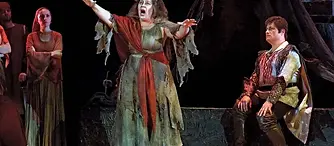
If you are new to opera, you might want to start with operas in English. Look for Amahl and the Night Visitors (Gian-Carlo Menotti) and Porgy and Bess (George Gershwin). Recordings are available of operas based on American events and people, such as Nixon in China (John Adams) and X: The Life and Times of Malcolm X (Anthony Davis). Be sure to read the story of an opera before you listen to a performance. Many operas are in German, French, or Italian. You might be able to find and read the libretto (the entire text) in English.
MUSIC IN AMERICA
If the information below could play the music of what you are about to read, you would hear the drums and chants of American Indian tribal songs. You would hear the music that sailed across the Atlantic from Europe: hymns, folk ballads, and symphonies. And you would hear the rhythms of Africa mingled with jazz, blues, and work songs.
This section will help you trace the development of music in America and fulfill requirement 3d. It will give you ideas about composers and performers whose lives and works you might like to investigate. The best way to learn about them is through listening to their music and reading books about their lives.
American music is the sounds of American life-of people praying, protesting, working, and celebrating. American music is a true melting pot of styles, ethnic backgrounds, and boundless experimentation.
AMERICAN INDIAN MUSICAL TRADITIONS
Some American Indian tribes believed new songs came in dreams or visions. Each song had a purpose: to assure success in hunting or battle, to heal the sick, or to praise a person's generosity. Traditional instruments included flutes, whistles, drums, and rattles made from gourds.
As American music developed, it rarely borrowed from American Indian music Meanwhile, tribes preserved their own music, songs, and dances. Today, many recording artists play traditional American Indian instruments. R. Carlos Nakai, who is of Navajo- Ute heritage, has included traditional tribal melodies in his compositions for the American Indian flute. The work of Mohican composer Brent Michael Davids has been performed at the Kennedy Center.
THE COLONIES
Religious music was a basic part of life in the Colonies. Early New England Puritans sang psalms, but they did not use musical instruments in their churches. The Moravians in Pennsylvania, however, included singing, organ music, and orchestral instruments in their religious services.
Settlers sang folk songs, lullabies, and sailors' chanteys from their home countries. As musical instruments from Europe became available, more music was played in Colonial homes. Traveling music masters taught the violin, flute, spinet, harpsichord, and guitar.
Slaves brought West African musical traditions and mixed them with the European-style music they heard around them. Techniques from Africa included complex rhythms, sliding notes, and the call-and-response form.
The first book of entirely American music was the New England Psalm Singer by William Billings, a Boston tanner with a passion for creating music. The book was published in 1770 on American- made paper, with a frontispiece (illustration) engraved by Paul Revere. Billings' compositions had an originality and energy that reflected the frontier spirit.
America's first hit was "Yankee Doodle." The verse that starts "Yankee Doodle came to town" was well- known before the Revolutionary War. The British sang it to insult the Colonials, but the Yankees adopted the tune and marched to war with it.
THE 1800s
Following the Revolutionary War, Americans built theaters and started philharmonic societies and symphony orchestras in the larger cities. Professional musicians arrived from Europe and gave concerts around the country. New Orleans became known for opera.
Francis Scott Key wrote the national anthem of the United States after the bombardment of Fort McHenry at Baltimore, Maryland, during the War of 1812. When Key saw the bedraggled American flag still flying above the fort at dawn, he dashed off to pen the words to "The Star-Spangled Banner" and set it to an old English tune called "To Anacreon in Heaven."
Settlers in the Southwest played the music of Spain and Mexico. Singing and dancing at
fiestas lasted for days. Musicians favored the guitar but also played the violin, harp, and
flute. Missions had their own choirs.
Many American families played music from sheet music and songbooks on upright pianos in
their homes. In the mid 1800s, Stephen Foster wrote popular songs you probably know,
such as "Oh! Susanna," "De Camptown Races," and "My Old Kentucky Home." The Civil War
inspired an outpouring of songs praising the bravery of soldiers and expressing the strong
feelings people had about the war.
Rural residents traveled to "camp meetings" to hear sermons by circuit-riding preachers.
People sang hymns, clapped their hands, and jumped for joy, creating a new style of song
called the spiritual.
Among African Americans, spiritual style included humming, joyful
moaning, and improvisation (spur-of-the-moment invention) around the
melody - more qualities from African heritage that would have lasting
influence on American music.
THE 1890s AND POPULAR MUSIC
In the 1890s, band music and ragtime swept the nation. The popularity of band music was due mainly to John Philip Sousa, who toured the country with his concert band. Sousa's marches, such as "Washington Post" and "The Stars and Stripes Forever," are a permanent part of American music.
By 1900, all of America danced to ragtime. Written mainly by African American pianists, the name comes from "ragged time," or uneven rhythm. While the pianist's left hand played a regular beat, the right hand played a syncopated (irregularly accented) melody. It was technically challenging music to play.
This complex, entertaining music has recently been revived among pianists. The popular 1973 movie The Sting used rags by composer Scott Joplin in its background score.
INTO THE 20th CENTURY
Elements of popular, folk, and classical music begar to mix in the 20th century, thanks to new technologies and the mass media. Some of the distinctly American styles that grew out of the mix are described briefly here.
The Blues
Around 1900, many African Americans moved from the rural South to cities. With them they brought "country" or "down-home" blues that came from work songs and spirituals. When this music met urban song styles, "city blues" resulted. Famous blues singers include Blind Lemon Jefferson, Gertrude "Ma" Rainey, and Bessie Smith. The composer W. C. Handy became known as "Father of the Blues" because he brought the music to a wide audience. Many consider "St. Louis Blues" to be Handy's masterpiece.
Jazz
BeTween 1900 and 1910, brass bands in the South started to "rag" their marches, and horns wailed like blues singers. Ragtime and blues set the stage for jazz, which has had enormous influence on both popular and classical music. New Orleans was the cradle of early traditional jazz, though jazz was played in other places, too. Elements typical of jazz. include improvisation around a melody, riffs (short repeated phrases), blue notes, and call-and- response between instruments or between a voice and instruments.
Jazz often is described as America's greatest contribution to world music. Important jazz pioneers include: Charles "Buddy" Bolden, Edward "Kid" Ory, Joseph "King" Oliver, Ferdinand "Jelly Roll" Morton, and Louis "Satchmo" Armstrong.
After Louis Armstrong started improvising trumpet solos, the solo became a basic in jazz. He also introduced "scat" singing, a solo of rhythmical nonsense syllables.
Big Band and Swing
Big band jazz came on the scene in the late 1920s with more instruments and danceable music. The bandleader Benny Goodman originated the lively sound of swing in 1935. Edward "Duke" Ellington-jazz pianist, bandleader, and one of America's foremost composers-created complex innovative jazz. Some leading vocalists with swing bands were Billie Holiday, Frank Sinatra, and Ella Fitzgerald.
Bebop
Swing moved too far from its jazz roots for some musicians. They rebelled in the early 1940s with bebop, or bop. Bop had complicated rhythms and harmonies meant for listening, not dancing. The trumpeter Dizzy Gillespie, the pianist Thelonious Monk, and the saxophonist Charlie "Bird" Parker, three of the best jazz improvisers, were important bop musicians.
Other Jazz Styles
More jazz styles followed. Cool, or progressive, jazz had a smooth, mellow sound and sometimes included the French horn, flute or cello. The trumpeter Miles Davis was a leading cool-jazz musician.
In the 1960s, saxophonists Ornette Coleman and John Coltrane were important to free jazz. Free jazz generally allowed all musicians in a band to improvise without being guided by a basic melody. Jazz-rock fusion combined jazz's improvisations with rock's rhythms and sound. This meant the addition of synthe- sizers, along with the electric piano, guitar, and bass. Miles Davis and the pianist Herbie Hancock were pioneers in jazz-rock fusion, which started in the late 1960s.
CLASSICAL MUSIC IN THE 20th CENTURY
During the first half of the 20th century, adventurous changes in classical music took place. Here are a few important modern composers.
-
Charles Ives (1874-1954) used complex rhythms and dissonances (combinations of tones that seem to clash). His highly original music is often playful and humorous. In his Holidays sym- phony, he created the effect of three marching bands playing different tunes all at once. His well-known works include "Three Places in New England" and "General William Booth Enters Into Heaven." Ives has been called the United States' first great composer.
-
William Grant Still (1895-1978) was the first African American composer whose classical music was widely published and performed. Still's Afro-American symphony has a blues theme. He set his Songs of Separation to the writings of famous black poets. His Ennanga suite is a tribute to his African heritage; his opera Mota is set in Africa.
-
George Gershwin (1898-1937) wrote popular songs, musical comedies, orchestral works, and opera. At 20, he wrote his first Broadway musical and then a string of hit songs and musicals. Gershwin's famous Rhapsody in Blue has a blues theme and jazzlike rhythms. His folk opera, Porgy and Bess, has been performed all over the world. George Gershwin's brother, Ira Gershwin (1896-1983), usually wrote the lyrics for George's musicals.
-
By the time he was 15, Aaron Copland (1900-90) knew he would be a composer. He studied in Paris, then returned home determined to write music that would be recognized as distinctly American. His music for the ballets Billy the Kid, Rodeo, and Appalachian Spring drew on American folklore.
-
Milton Babbitt (1916-) built on the work of Arnold Schoenberg (1874-1951), an Austrian composer whose "serial music" repeated a pattern of 12 selected tones. Babbitt extended this method to patterns of rhythm, timbre, dynamics, and instruments for "total serialization." The result is complex interwoven music. In the 1960s, Babbitt was one of the first composers of electronic music. He also mixed electronic music with live performances by singers and instrumentalists.
-
John Cage (1912-92) composed music based cn chance. Each performance of a Cage composition is unpredictable. Some of Cage's works are for "prepared piano," a piano with its tones altered by objects such as coins, screws, hairpins, and bits of wood and rubber placed among the strings. In Fontana Mix, Cage's written music is a set of flowing-line drawings, transparent pages, and a graph that can be combined in several ways. Performers are free to interpret the result, which looks like a cross between modern art and a road map.
MUSICAL THEATER
America's first musicals were revues, in which the plots were just excuses to te songs together. At that time, songwriters were more interested in creating hit tunes that would sell sheet music than telling stories.
But that changed in the 1920s when composers and lyricists began to link better
stories with songs. Show Boat led the way, with its serious plot, music by Jerome
Kern, and lyrics by Oscar Hammerstein II. Its songs, such as "Ol' Man River," were
threaded into the plot and helped the audience understand the characters.
Leonard Bernstein (1918-90) was an extremely versatile composer of musicals,
opera, ballet, choral works, and symphonies. He often used syncopation and jazz
and dance rhythms in his work. He composed the exciting music for West Side
Story, which combined music, drama, and dance in a new way. The story, based
on Shakespeare's Romeo and Juliet, is set amid New York tenements and deals
with young love and teenage gangs. The action is both comic and tragic. The
songs, with lyrics by Sondheim, range from beautiful to tough to funny.
POPULAR MUSIC
Whatever style of today's music you like, you can be sure it has a history. The
music sounds the way it does today because it has been shaped along the way by songwriters and performers. Pop, jazz, folk, blues, country, bluegrass, gospel, rock, and rap have borrowed from one another, and many artists work in several genres.
POP
Pop covers a wide territory: romantic songs, novelty tunes, songs with messages, movie themes, and more. Radio "crooners" with soft, almost whispering styles were popular in the late 1920s. In the 1940s, big-band singers like Frank Sinatra became sensations. After World War II, a stronger economy meant teenagers had money to buy records. New music was written to appeal to the young consumers.
COUNTRY
Country music developed from British ballads and folk songs that were preserved in the South. In the mid-1920s, adio shows such as the National Barn Dance in Chicago and the Grand Ole Opry in Nashville began to broadcast this "hillbilly music" to a wider audience.
But the music was already changing. Jimmie Rodgers combined the Southern mountain ballad with the blues and a vocal embellishment called the yodel to produce a new style of country. Rodgers' songs were among the first to attract a national audience to rural Southern music.
Country music turned to the West with the success of cowboy movies in the 1930s and 1940s. Honky-tonk music followed and dealt with subjects like love and loss. Later, a new relaxed style with an easy beat, known as "the Nashville Sound," developed.
Country music's popularity has grown with the rise of stars such as Willie Nelson, Dolly Parton, Garth Brooks, Tim McGraw, Brooks & Dunn, George Strait, Alan Jackson (left), Lee Ann Womack, Faith Hill, and many others.
BLUEGRASS
Country music gave birth to a new style called bluegrass, pioneered by Bill Monroe and his band, the Blue Grass Boys, beginning in 1939. Bluegrass is characterized by complicated vocal and instrumental solos and distinctive vocal harmonies including duet, trio, and quartet harmony singing. A typical bluegrass band has guitar, banjo, fiddle, mandolin, and bass. Bands sometimes feature a kind of steel guitar called a reso phonic guitar.
Lester Flatt and Earl Scruggs were important bluegrass performers from the 1940s through the 1960s. Among the major bluegrass groups of recent years are the Nashville Bluegrass Band, Hot Rize, and Alison Krauss with her group Union Station. Earl Scruggs wrote one of bluegrass music's most famous instrumentals, "Foggy Mountain Breakdown," which was used in the soundtrack of the 1967 film Bonnie and Clyde. Deliverance (1972) also featured bluegrass, the famous "Dueling Banjos." In 2001, the soundtrack for O Brother, Where Art Thou? exposec more people to bluegrass and traditional country music.
GOSPEL
The father of gospel music, mcst experts agree, is Thomas A. Dorsey, composer of such well-known songs as "Take My Hand, Precious Lord" and "There Will Be Peace in the Valley." As a young blues pianist, Dorsey accompanied blues singers Bessie Smith and Ma Rainey. Then he began to write religious music that had jazz rhythms and blues flavor. Gospel emerged from the African American church to reach an ever-widening audience. The golden age of gospel was from 1945 to 1965, but the tradition and the music thrive today. The gospel style is vigorous, fervent, and intensely spiritual. Famous gospel performers include Mahalia Jackson, Clara Ward, Sister Rosetta Tharpe, the Mississippi Mass Choir, James Cleveland, the Mighty Clouds of Joy, and the Five Blind Boys of Alabama.
FOLK
Folk music in the 20th century has often featured songs of protest against conditions of the day. Woody Guthrie wrote protest songs as the nation struggled with the poverty brought on by the dust storms and economic troubles of the 1930s. You might know his song "This Land Is Your Land."
In the late 1950s and early 1960s, folk singing became especially popular. Folk artists such as Pete Seeger, Joan Baez, Judy Collins, Bob Dylan, and Peter, Paul, and Mary rose to fame.
ROCK
Teenagers claimed rock 'n' roll, the new music that emerged in the mid-1950s, as their own music. Today's rock music evolved from early rock 'n' roll to cover a wide variety of vocal styles and instrumentation. Rock music has roots in rhythm and blues (R & B), which combines blues, jazz, and gospel styles. R & B has a powerful beat and loud, intense music and vocals. Little Richard and Chuck Berry were prominent R & B artists. Rock also drew from coun- try music. A typical rock song has a driving beat, lots of volume, and simple repetitive phrases.
The first rock 'n' roll hit was "Rock Around the Clock" by Bill Haley and His Comets in 1954. In the late 1950s, Elvis Presley launched his career and was on his way to becoming the King of Rock 'N' Roll.
The Beatles from Liverpool, England, toured the United States in 1964 and revolutionized rock. They sang sophisticated lyrics in styles that ranged from ballads to hard rock. Their influence encouraged other rock groups to expand styles, instrumentation, and electronic effects.
In the 1960s, James Brown, Ray Charles, Aretha Franklin, and others sang rock music called soul. Detroit became a center for black singers, and the "Motown" sound developed there. Well-known Motown singers include the Temptations, Smokey Robinson and the Miracles, and Diana Ross and the Supremes.
Some famous names in rock are the Beach Boys, Eric Clapton, the Grateful Dead, Jimi Hendrix, the Rolling Stones, Bruce Springsteen, Tina Turner, U2, and Stevie Wonder.
From the 1970s through the early 2000s, rock evolved and branched into different styles that, in turn, influenced each other. Punk, heavy metal, and rap are three main rock genres.
HEAVY METAL
Heavy metal is loud, theatrical, aggressive, wild and raw, and often controversial. Metal music has been criticized for its themes of death and destruction. Many heavy metal songs express anger or desperation and intense feelings of alienation.
Metal music takes advantage of the modern electric guitar's abilities to make unusual sounds through effects such as feedback, distortion, and reverb (an electronically produced echo. effect). Metal borrows from rock 'n' roll and the blues, with influences from classical music.
Early punk bands such as The Ramones and The Clash set the stage for New Wave music (with electronic influences) of the 1980s and Grunge music (with heavy metal influences) of the 1990s, inspiring artists such as Elvis Costello, New Order, Talking Heads, and Nirvana.
RAP
Rap, with its rhythmic spoken lyrics, is a kind of street poetry set to music. Rap speaks openly about tough topics. Rap artists often talk about the hardships and violence experienced by many young African Americans in big cities. The lyrics of some rap songs have caused controversy for their emphasis on racism and violence. The term "rap" comes from a 1960s slang word for "conversation." Rappers often speak or chant their songs to electronic beats and the sounds of records being scratched.
Rap grew out of African American street culture in New York City during the 1970s. It became the most popular new music to emerge in the late 20th century. Early rap groups included Grandmaster Flash and Afrika Bambaataa. Performers such as Salt-N-Pepa and MC Hammer WILL SMITH BORN TO REIGN brought rap to a mainstream audience. Other influential rap performers have included Run-DMC, Queen Latifah, and Arrested Development.
A MIXTURE OF MUSIC
Musicians today often blur the line between classical and popular music. Josh Groban sings pop, rock, opera, and classical. Rock star Paul McCartney writes classical music. Jazz singer Bobby McFerrin and classical cellist Yo-Yo Ma performed together. Opera star Kathleen Battle sang with pop star Janet Jackson. Rock composer Prince wrote the score for the Joffrey Ballet's Billboards. The Kronos Quartet (a string quartet) performed works by Ornette Coleman, Charles Ives, and Jimi Hendrix. Christopher Rouse composed work influenced by Beethoven, Indian raga music, and Elvis Presley. The music of America developed out of international musical traditions and forms. But jazz, blues, and musical theater are America's unique contributions to the world of music.

The mariachi band has a colorful history dating back hundreds of years. The modern-day mariachi band, such as this one, often will have violins, guitar, trumpets, the vihuela (a small five-string guitar), and the guitarrón (six-string bass guitar).

Oklahoma! began the modern era in 1943. Richard Rodgers, composer, and lyricist Oscar Hammerstein II created songs such as "Oh, What a Beautiful Mornin" to express the spirit of the time, place, and characters. Together, the songs and dances told the story.
JOINING A MUSICAL GROUP
Par of the fun of being a musician comes from sharing your talent and love of music, practicing with other musicians, and performing music for audiences to enjoy. If you sing or play an instrument, it should be easy to find a musical group to join.
Schools have choruses, orchestras, marching bands, and drum and bugle corps. Many have smaller groups such as string quartets, brass ensembles, and jazz bands. Places of worship have choir, bell choirs, and other vocal and instrumental groups. You might join a community orchestra or chorus. Local groups might preserve cultural music traditions and give you the chance to express your heritage.
Your teacher can help you decide when to join a group. Singing or playing with others is quite different from working sola. You watch the conductor and play exactly as he or she directs: softly or loudly, more quickly or slowly. You watch for your cue to play. You learn to continue with your part while other instruments play around you. You also learn to blend your part with the rest, developing a sense of ensemble playing.
Why not take the lead in organizing a drum and bugle corps that will be a source of pride to your troop and a feature in community parades? Troops also have other kinds of musical groups. Using the guidelines in this section, you might help your troop organize an ensemble, band, or singing group, especially if there are no other local musical groups for you to join for requirement 4c.
DRUM AND BUGLE CORPS
It takes only a few drums and bugles to sound like a sizable unit. Two snare drums, a bass drum, and a couple of bugles blend well together. For more impact, add cymbals, another bugle or two, and perhaps three or four fifes. Now the combination can handle march music, bugle calls, drill signals, and music for camp ceremonies and other Scouting occasions.
ENSEMBLES
Two violins, a viola, and a cello make a string quartet. With two trumpets, a French horn, a trombone, and a tuba, you can have a brass quintet.
JAZZ COMBO
A jazz combo has two sections: a melody "front line" that performs most of the solos, and a rhythm "back line." The front line has one to five brass and reed instruments: trum- pet, trombone, clarinet, and alto and tenor saxophones. The rhythm section has a piano, bass, drums, and sometimes an acoustic or electric guitar.
ROCK BAND
Electric guitars and drums are the basic instruments in a rock band. A piano or synthesizer might be included, too. Many rock bands have four or five members. The Beatles are a classic example of a four-instrument band, with lead guitar, rhythm guitar, bass, and drums. Other bands are larger. Chicago adds trumpet, trombone, and tenor sax to guitar, bass, keyboards, and drums to total eight members.
A CAPPELLA GROUP
A cappella is Italian for "in chapel style." It means singing without instrumental accompaniment. A barbershop quartet is an example of an a cappella group. An American style of harmony, it uses four voices: tenor, lead, baritone, and bass. The four voices make a com- plee four-part chord on almost every note, creating the distinc- tive sound of barbershop quartets. In most choral singing, the highest voice sings the melody. But in barbershop quartets, the second- highest voice, called the lead, sings the melody.
LEADING A GROUP
You will learn that you do not have to be the world's best singer to teach or lead songs.
TEACHING A SONG
These tips will get you started and help you relax and have fun, too.
-
Practice the words and the melody of the song you will teach until you know the song by heart.
-
Smile at the group. Be enthusiastic and act confident, even if this is your first time teaching a song.
-
Start with a lively, well-known warm-up number, so everyone (including you) can sing with confidence.
-
Tell the group the name of the song, and provide copies of the lyrics. Use songbooks or song sheets, or write the lyrics on a blackboard or large sheet of paper.
-
Sing the song through alone or with a small group that already knows it.
-
Then sing phrase by phrase and have the group repeat after you. If the song has several verses, teach one verse at a time.
-
When the group has learned the phrases or verses, sing the song all together. If the song is fast or difficult, sing it slowly at first, then pick up speed as the singers master it.
-
Musical accompaniment helps. Piano, accordion, guitar, and harmonica are good accompaniments because they can play harmony, not just the melody.
-
When the group has sung the song a time or two, stop. Do not work so hard that it is no longer fun. Go at once to a familiar song.
LEADING A SONG
Because teaching is a part of song leading, many of the previous tips apply to both. Here are a few more hints to help you lead songs successfully.
-
Give the starting note. Sing or hum a few bars of the song. Or, have a few bars played, if an instrument is available. Be careful not to pitch the song too high or low. If you start the group on the wrong note, stop and start over.
-
Start with a slight upward arm motion followed by a decisive downward motion (a downbeat), and begin singing. Do not worry if some don't start with the first note. They will join ir quickly.
-
Beat time with a simple down-and-up motion of the arm. Hold your arm high enough for everyone to see, and make your gestures definite and brisk. You are in command.
-
Control volume by raising your free hand for loudness and lowering it for softness. Do not beat time with both hands at once.
-
Move around a little, put some energy into it, and smile.
-
Stop while everyone is still having fun. Leave the group wanting more.
COMPOSING MUSIC
KEYS AND SCALES
Prepare for requirement 4B by reviewing what you know (or need to learn) about keys. Music is said to be in a particular key when it is based upon the scale starting with the key note (the first note) of the same name.
For example, music in the key of C major is based on the scale of C major. The scale of C major is CDEFGABC. Keys are indicated by key signatures-the sharps (#) or flats (b) are placed to the right of the clef.
FOUR-NOTE COMPOSITION
Pick a scale, and from it choose four notes. Play or sing them as whole notes, half notes, and quarter notes. Rearrarge the order of the notes, sometimes omitting a note or two. Experiment with and create patterns of notes and rhythms. Repeat and vary the patterns.
Listen to the results. Trust what your ear tells you. When you hear something you like, repeat it several times to help you remember it. Change things you do not like. Experiment freely, trying different musical ideas. Do not worry about whether your tune is good. The important thing is to enjoy making your own original music.
Many experienced musicians recommend using only four notes for
your first compositions. The four-note limit keeps things simple,
helps you focus, yet allows you to express many distinct musical
ideas. Start and end your melody on the first note of the scale. This
will help give shape to your music and also help you stay in one key.
NOTATION
You probably know that written music is called notation and is written on a five-lined staff. A composer can indicate much more on this staff than the notes to be played. As you compose, remember the following important points.
All music is made of two things: sound and silence. Sound has the following qualities: pitch (the height or depth of the sound), timbre (tone quality), duration (length), and dynamics (loudness and softness). Music is linked to time and has move- ment; one sound leads to the next. By organizing the sounds through rhythm and tempo, a composer creates an original piece of music.
A composer indicates the qualities of sound and move- ment when writing a composition. Some of the qualities, such as rhythm, pitch, and time, will appear as notation on the staff. Others appear as written directions, such as "presto" (fast) or "fortissimo" (very loud).
Your composition of 12 measures or more, which you should write for your own instrument or voice, must include these basic elements: (1) a staff, (2) a treble or bass clef sign, (3) the key signature, (4) the time signature, and (5) the correct time value in each measure of the score. (See the illustrations that follow.) Give your composition a title that fits the mood or spirit of the music. Add any written directions you need to indicate tempo and expression, and there it is: an original composition of your musical ideas, written down to keep.
Clefs indicate the pitch of the notes written on the staff. The treble clef shows music for the higher (soprano and alto) voices and instruments, the guitar, or the right hand on keyboard instruments. The bass clef shows music for the lower (tenor and bass) voices and instruments, or the left hand on keyboard instruments.


TRADITIONAL INSTRUMENTS
All over the world, people sing and dance to the music of instruments they make themselves from materials at hand. For optional requirement 4C, you may make one of the instruments shown here or an instrument of your own choice. However, it must be an instrument actually used in a specific culture. Your own cultural heritage or ethnic background might give you ideas. Or, look in your local museum for native instruments from your area. Visit the library to find ideas from around the world.
You should be able to tell who used the kind of instrument you made, on what occasions the instrument was played, and what materials were used to make it.

Bamboo xylophone-Southeast Asia. Use pencil-thin sections of hollow bamboo. Sand both ends of each bamboo section. Arrange the sections in scale order, then bind them into place. To play, strike the bamboo with a small wooden or hard-rubber mallet.