STEP 1 - Subscribe
Select your HomeScouting Adventure Club subscription. Choose a monthly payment option or subscribe for a year to save! NOTE: Your payment will begin in September for the HomeScouting Adventure club in exactly how many days the "free trial" states is left.
STEP 1 - Subscribe
Select your HomeScouting Adventure Club subscription. Choose a monthly payment option or subscribe for a year to save! NOTE: Your payment will begin in September for the HomeScouting Adventure club in exactly how many days the "free trial" states is left.


THE TRAIL
WELCOME TO THE TRAIL
Welcome to The Trail! Each month of the HomeScouting Adventure Club for Scouts BSA will be focused on a merit badge. Below you can complete all of the requirements for Traffic Safety merit badge. Scouts are encouraged to find a local merit badge counselor to fully complete the merit badge. The HomeScouting Adventure Club will provide a limited number of merit badge counselors to have small group merit badge sessions.
When you're ready, get started on your HomeScouting Adventure!
Looking for last month's merit badge? Click the Link Below!
Need a Merit Badge Counselor?
Make sure to download the connected worksheet for this month's adventure!
OCTOBER ADVENTURE:
TRAFFIC SAFETY


TRAFFIC SAFETY: SO IMPORTANT IT COULD SAVE YOUR LIFE
Staying safe in traffic wherever you live is getting more difficult all the time, as more and more people take 10 the road. This pamphlet will help you earn your Traffic Safety Merit badge and will give you some crucial tools to stay safer, whether you are driving a car on a highway, riding a bike across town, or jogging across a busy street.
Whether you live in a rural area or in the cities and suburbs, traffic is a fact of life. You can be surrounded by pristine wilderness and still be in the middle of a traffic jam. Just ask
the thousands of tourists who drive or bring their vehicles to Alaska via the ferry system every summer, clogging the states few major roads and slowing traffic to a crawl.

Accidents can happen in a split second. Even experienced drivers might take their eyes off the road a moment too long or go into a skid on an icy road. As a young driver, you should be aware that teenagers in the United States are far more likely to have a serious traffic accident in their first year operating a motor vebicle tban any other age groLtp. Why? ll comes dowo to a combination of factors from inexperience to the sense of invincibility and exhilaration young people sometimes feel when they first get behind the wheel of a 2-ton car. Combine alcohol or drugs with driving and the results are often deadly. As a new driver it is critical that you develop a combination of defensive, proaclive skills to help you stay safe on the roads.
THE COST OF CAR CULTURE
Americans love their cars. We spend at least half as much 1ime stuck in traffic each year as we do going on an annual vacation. Wherever you live, commutes to school or work are getting longer and more snarled with traffic.
The problem is that we rely on our vehicles for our daily needs. Trucks deliver food and other items to stores for us to buy and use. Emergency vehicles such as fire trucks and police cars respond to emergencies. Yet for all the advantages of motorized transportation, there is a big price to pay. Motor vehicle crashes are the leading cause of death among people ages I through 34 and the leading cause of injury (or all age groups.
Vehicular accidents lead LO tremendous social and economic costs. When someone is killed in a car crash, a whole range of people from family members to friends and acquaintances feel the terrible loss. Economically, in addition to lost wages, crash injuries contribute to expenses for medical care, emergency services, nursing-home care, rehabilitation, home modifications, insurance administration, and property damage that amount to billions of dollars each year.
However, the biggest price society pays for transportation accidents is personal. Lives can change in an instant. Just imagine how parents feel when they get a phone call telling them that their child has been injured or killed in a car accident.

Young people 16 to 20 years old have the highest fatality and injury rates per 100,000 population, according to the National Center for Statistics and Analysis. In 2004, motor vehicle accidents in the United States killed more than 42,000 people. Imagine a football stadium full of people, and you will get an idea of how many people die in car accidents each year. Of this staggering number, more than 26,000 were drivers, more than 10,000 were passengers, and the rest were pedestrians and bicyclists.

THE PERILS OF IMPAIRED DRIVING
Motor vehicle crashes are the leading cause of death in the United States for young people, and an alarming number of these crashes are related 10 alcohol or drug abuse. Alcohol- impaired driving is highest among persons 21 to 24 years old, and the percentage of fatal crashes that are alcohol-related is highest for this age group.
However, even for the youngest drivers, alcohol-related crashes are a serious problem. Not only a.re drivers under the age 21 more likely than older drivers to be involved in fatal crashes, but their added risk for fatal crash involvement increases more sharply a1 all levels of alcohol use.
Alcohol and drugs are perhaps the most publicized causes of impaired driving. but they are not the only causes. Each year a considerable number of serious crashes occur as a result of drivers who are impaired by fatigue and drowsiness.
ALCOHOL & DRIVING
Alcohol is a depressant. It slows down the functioning of the brain and 1he nervous system. The physical and mental skills needed to operate a vehicle safely, along wiU1 clear vision, are impaired when a person drinks and then gets behind the wheel.
Alcohol impairs the following skills and abilities:
-
Multitasking-Research suggests that the most serious effect of alcohol on a driver is that it reduces the driver's ability to handle several tasks al one time.
-
Reaction time-Alcohol slows the driver's ability to react to sudden events on the road.
-
Tracking-Drivers under U1e influence of alcohol have trouble continuously observing the position of the vehicle with respect to the road and keeping the vehicle in the correct location.
-
Comprehension-Alcohol diminishes the driver's ability lo perceive hazards on the road.
-
Attention span-Alcohol reduces the driver's alertness over an extended period of time.
-
Coordination-A drunken driver cannot handle tasks that require high levels of precise movement.
BLOOD ALCOHOL CONCENTRATE
Blood alcohol concentration {BAC) is the amount of alcohol in the bloodstream. It is measured by the weight of the alcohol in relation to the blood. BAC can be measured by breath, blood, or urine tests within 30 to 70 minutes after someone has had a drink.
It is more accurate to refer to alcohol-impaired driving rather than intoxicated (drunken) driving because a person does not have to be legally intoxicated to be impaired. In all 50 states, the legal standard for intoxication is a BAC of 0.08. However, studies have shown that impairments first appear at BACs as low as 0.02. Driving skills, especially judgment, are impaired
in most people long before they show obvious signs of drunkenness.
Factors that affect BAC include the following:
-
Amount of alcohol consumed. The more a person drinks, the higher the BAC level will be.
-
Body weight. Heavier people are not as quickly affected by alcohol as lighter people.
-
Food in the stomach. When the stomach has food in it, the bloodstream absorbs alcohol more slowly.
-
Gender. Women reach higher BACs faster than men. Therefore, if a man and woman, with all other factors being equal, are both drinking the same amount of alcohol, the woman will have a higher BAC level.
-
Type of alcohol consumed. The higher the alcohol content of a drink, the more quickly it is absorbed. Distilled spirits (whisky, vodka, rum, gin) have the highest concentration of alcohol, followed by wine and then beer.
-
Speed at which a person drinks. The liver can process and eliminate only about one drink per hour (one drink= 1.5 ounces of 80-proof distilled spirits; 5 ounces of wine; or 12 ounces of beer). If a person drinks more quickly than this rate, the excess alcohol will remain in the bloodstream and elevate the person's BAC.
CONSEQUENCES OF DUI/DWI
The laws regarding driving under the influence (DUI) or driving while intoxicated (DWI) in the United States are very rigid. It is illegal in all 50 states to drive with a BAC at or above 0.08 percent. ln a majority of states, drivers who are found to have a BAC of 0.08 or higher will have their licenses revoked or suspended under a procedure called administrative license suspension. Drivers who refuse a BAC 1est will also have their licenses suspended or revoked. These administrative suspension laws, which go into effect right after an arrest. have proved to be more effective than laws that did not suspend or revoke a license until after a person was convicted of alcohol-impaired driving.
The consequences of DUI/DWI vary but can include some or all of the following: fines, license suspension, license revocation. mandatory alcohol-awareness classes, community, and jail time. Repeat offenders will likely serve time in jail, be required to participate in an alcohol-abuse program, and also may need to enroll in an Alcoholics Anonymous program.
Other circumstances can make the punishment harsher. Drivers under the influence who have a child in the car with them, who are speeding, who refuse to take a BAC lest, who have prior DUI/DWI convictions, or who cause an accident or injury will receive stiffer penalties. In most state, if a drunken driver injures someone, it is considered a felony. If the person dies, the driver can be charged with manslaughter or murder.
A conviction for DUI/DWI for driving under the influence of alcohol or drugs can cost a person as. much as $15,000 as a
result of attorney's fees, increased insurance rates, towing fines, court costs, and bonding fees. A person's license may be suspended or revoked. A conviction can prevent a person from getting a job or a promotion, and it can even get the
person fired.
DID YOU KNOW? Most states have open-container laws that prohibit the driver or other occupants of a vehicle from
having open containers of alcohol in the passenger compartment of the vehicle. Penalties for those convicted of violating
open-container laws vary from state to state but include fines and community service. Find out what the open-container
law is in your state.
ZERO TOLERANCE LAWS
Young drivers arc particularly susceptible to impairment by alcohol. During a typical weekend, one teenager dies every hour in a car crash. Nearly 50 percent of those crashes involve alcohol. Safety advocates have argued that teens should not drive if they have had any amount of alcohol, which has led to support for zero-tolerance laws. All 50 states have enacted zero-tolerance laws for drivers under age 21. These laws set the BAC limit of 0.00 (no detectable level) to 0.02 percent as the legal limit. Underage drivers found to be under the influence may be fined and/or have their license suspended. In addition, they may be required to attend alcohol-education classes and perform community service.

MADD and SADD
A drunken driver can cause much hardship and suffering, the ripples of which are felt throughout communities nationwide. Many survivors and the families and friends of victims look for ways to prevent others from going through the same pain. Organizations such as Mothers Against Drunk Driving (MADD) and Students Against Destructive Decisions (SADD) believe that hearing from those whose lives were forever changed by an alcohol-related driving accident can help deter potential drunken drivers.
A drunken-driving impact panel is often effective in educating drivers to the dangers of drinking and driving. Transportation officials, a safety officer at your school, or nonprofit organizations such as MADD and SADD can help you put together a panel discussion. These panels consist of three to four people who speak to audiences about the alcohol-related crashes in which they were injured or in which a loved one was killed or injured and how it affected them. Judges or probation officers often require convicted DUI/DWI offenders to attend an impact panel as part of their sentences. It is a good way to bring home the real-life consequences of mixing drinking with driving. After attending panel presentations, many offenders resolve to never again drive after drinking.

DRUGS AND DRIVING
Using marijuana also impairs many of the skills needed for driving a car. Effects may include difficulty in judging distances and delayed reactions to sights and sounds that drivers absolutely need lo notice, much like the effects of drinking alcohol. When users combine marijuana and alcohol, the hazards of driving become even more serious. Driving while under the influence of drugs is more common among drivers ages 16 to 20 than any other age group.
A DEADLY MIX
Research shows that:
-
Marijuana is harmful to the brain, heart, lungs, and immune system.
-
It limits learning, memory, perception, judgment, and complex motor skills such as those needed to drive a vehicle.
-
People under the influence of cocaine become easily confused and lose the ability to think clearly for any length of time.
-
Inhalants can cause damage to the heart, kidneys, liver, brain, and other organs.
Many people believe that only alcohol, marijuana, and other "hard" drugs impair their abilities. Prescription drugs and over-the-counter medicines such as antihistamines for colds and allergies can cause drowsiness and other side effects, too. Every year some crashes are caused by drivers who are not alert because of medicine they took. The danger is even greater for a person who is taking more than one medication. The interaction of two or more medicines may impair driving in ways that catch the driver by surprise. Warnings on prescription bottles-such as those advising drivers to stay off the road when on the medication should be taken seriously.
YOUR RESPONSIBILITY AS A PASSENGER
Even when you are a passenger, you should pay attention to the condition of the person who is driving the vehicle. You might think that young victims of drunken drivers are usually in a car !hat is hit by the intoxicated driver or that they were hit while walking or riding their bikes; however, a study of children who died in alcohol-related crashes revealed that nearly two-thirds of those children were riding with the drunken driver. Two-thirds of drunken drivers studied were parents or adult caregivers, while most of the others were young drivers. Even if you experience peer pressure to get in a car with a group of friends who have been drinking or you are at a family event where a parent has been drinking. your life and the lives of others may depend on your having the judgment and the courage to say, 'Tm not riding with you because you've been drinking."
ASLEEP AT THE WHEEL
Most people know that drinking and driving is dangerous, but they may not realize that driving while drowsy can be just as
fatal as driving while drunk. Fatigue or lack of sleep can cause a driver to fall asleep at the wheel or to not pay attention while driving. Fatigue slows reaction time, dulls awareness, impairs judgment, and consequently increases the risk of crashes. Research into sleepiness focuses on the hL1man biological clock. Everybody has a biological clock that plays a role in controlling hunger, energy levels, and body temperature. Most people's biological clocks make them especially likely to feel sleepy at three specific times during the day. One is the afternoon lull from 2 p.m. to 5 p.m. The others are early in the morning and late at night, which is by far the most dangerous time for drivers.
When you drive, pay careful attention to the behavior of other drivers near your vehicle. If you see them weaving, drifting into another lane inexplicably, heading for a ditch, or exhibiting any other unusual behavior, actively avoid them-slow down and stay in back of them. If you yourself start feeling drowsy while driving, get off the road immediately. Get out and take a brisk walk to wake yourself up, or have someone who is well-rested take the wheel.
THE RISK ZONE
Driving while fatigued is a transportation concern being addressed by the Boy Scouts of America. The BSA hopes to raise awareness of the dangers of drowsy driving with the help of the Risk Zone campaign. The following driver's pledge is an
important piece of the campaign and emphasizes that planning is the best defense against killer fatigue.

KEEPING US ALIVE THROUGH ROAD DESIGN
The need for better and safer roads is a constant challenge for engineers. In this section you will learn to look at streets and roads through the eyes of a highway engineer. Highway engineers design roads using scientific principles and standards that help keep drivers safer and cyclists and pedestrians safe. A highway engineer has much responsibility and many factors lo consider when designing a road.
THE ROLE OF THE FEDERAL HIGHWAY ADMINISTRATION
The Federal Highway Administration (FHWA) is a federal agency that helps develop and improve the nation's transportation system. Among the chief responsibilities of Ihe FHWA is the improvement of roadway safety. The FHWA seeks to educate the public about roadway safety and to find ways to reduce the number of pedestrian fatalities, intersection fatalities, and road departure fatalities-deaths that occur when a vehicle leaves its designated lane.
Roadway Safety Features
Rumble strips, retroreflective signs and markings, and special roadway hardware are some of the safety features highway engineers incorporate in their roadway designs. Rumble strips are small indentations or raised strips on the pavement that, when driven over, make noise. Rumble strips alert drivers when they are veering off the road or heading into a different lane. Retroreflective signs and pavement markings help nighttime drivers. Made from a material that bounces light from headlights back to drivers' eyes, such signs and markings are quite easy to see at night. Forgiving roadside hardware (such as guardrails and breakaway poles) skid-resistant pavement, and all-weather pavement markings also help prevent or minimize the severity of accidents.
About 40 percent of all crashes occur at intersections. To make intersections safer for drivers, pedestrians, and bicyclists, traffic engineers have made improvements to the timing mechanisms of traffic signals. They also have improved signage, added exclusive turn lanes, and built roundabout-circular intersections that eliminate certain intersection conflicts such as left turns.
To improve safety specifically for pedestrians, traffic engineers make improvements 10 lighting to enhance visibility and construct islands on medians that give pedestrians a safe place to stop when crossing a multilane street or road. For blind and low-vision pedestrians, traffic engineers add special audible signals that help them know when it is safe to cross a street and truncated domes that help them detect the boundary between the sidewalk and the street.
Speed
When a new road is built or an old one rebuilt, one important decision that guides the design is what the speed limit will be. Common sense dictates that if a driver can just barely negotiate a curve safely while driving 30 miles per hour, the curve will be too sharp for an interstate highway where the speed limit is 65 to 75 miles per hour. For example, if engineers know that the project is for a rural two-lane highway with a speed limit of 55 miles per hour, they can research the correct standards to find out how they should design lane and shoulder widths, curves, grades, pass.ing zones, and intersections. When the road is built, it will be safe to drive at 55 miles per hour.
Uniformity
Imagine you and your family are driving from your home in Pennsylvania to the Grand Canyon in Arizona. When you get to Indiana, the stop signs are blue circles instead of red octagons. In Colorado, all the road signs look like pine trees, and you cannot see them well at night. To keep this traffic-safety nightmare from happening, the FHWA makes sure every state adheres to its Manual on Uniform Traffic Controls Devices, which tells traffic engineers which signs are needed, what they must look like, and where they must be installed. You will learn more about signs, signals, and pavement markings in the "Navigating the Road" section.
RUMBLE STRIPS
Rumble strips help keep roads safe because they increase driver attention. The textured patterns of rumble strips will not damage a vehicle and can safely be driven over at the speed limit. They may be used in the following roadway locations:
-
Across a road when there is a tollbooth ahead or when there is an unexpected stop sign or traffic signal after a long stretch of uninterrupted roadway
-
Along the shoulder of rural highways, especially interstates, to alert drowsy drivers that they have begun to drift onto the shoulder
-
In the center of a two-lane road to warn of the danger of passing
ACCOMMODATING ALL ROAD USERS
Traffic engineers must be mindful of the needs of all the people who will use the roads. With an increasing number of older drivers in our society, engineers must pay special attention to making signs more visible and intersections and interchanges less confusing. An engineer also must consider the needs of younger drivers. A teenage driver, for example, may lack the experience to anticipate hidden hazards that can cause crashes. Nor can the engineers fail to address the needs of people with disabilities. Someone who walks with a cane, for example, will take longer to cross the street than other pedestrians and, thus, traffic signal timings will need to be long enough to allow them to safely get across an intersection. Curbs must have ramps so people in wheelchairs can safely cross the street.
Intersection, Lane, and Visibility Safety Issues
Intersections are the most dangerous locations in urban areas. Based on volume of traffic and other factors, a traffic engineer needs to decide if a traffic signal is necessary and whether there ought to be separate left-turn or right-turn lanes. Parking must be prohibited near intersections so that drivers can clearly see other cars and pedestrians. Room for a bus stop may be needed. If there is a traffic signal. crosswalks and "Walk/Don't Walk" signals must be included in the design.
Lane safety, is also important to road engineers. They need to figure out how many lanes are needed to prevent congestion and move traffic along smoothly. They also need to determine how wide the lane should be to permit safe travel at the speed limit. On a quiet residential street, lanes may need ro be only 10 feet wide, while a high-speed freeway requires 12-foot lanes.
On high-speed, high volume, highways, it is important to separate lanes of opposing directions of traffic to prevent head-on crashes. Engineers prefer wide grass median between lanes so oncoming cars have room to stop or recover if they leave the left side of the roadway. Also important are shoulders on suburban or rural roads where drivers can safely stop in case of an emergency. To prevent accidents that could happen as vehicles enter and exit interchanges on expressways and freeways, traffic engineers include acceleration and deceleration lanes.
Visibility is important in all road design. A driver needs to be able to see hazards ahead to have time to make a decision to stop if necessary. It is impossible to see over the crest of a bill or around a curve. Engineers try to design roads so hazards such as intersections aud railroad crossings are not hidden from view. Signs and pavement markings must be visible not just in bright daylight but in dark nighttime conditions as well as in poor weather. Proper street lighting is important, especially in urban areas where pedestrians are present.
Terrain is another major consideration in an engineer's design of a new roadway. Sharp curves and steep hills can cause drivers to lose control and run off the road. Engineering gentle curves and grades is the desirable solution. Whenever nossible. the road is designed so that it can be driven safely at the posted speed limit. Sometimes, however, the terrain makes it impossible to meet the design speed standard for curves or grades, and in that case, warning signs are posted.
Roadside Hazards
Keeping motorists alive through good road design also means paying attention to the roadside. In more than one-third of all highway fatalities, the side of the road is a factor. Various factors can cause a vehicle to leave the roadway, including distractions, vehicle malfunctions. traffic situations, and poor road conditions. Whatever the reason, once a vehicle leaves the roadway, the results are often catastrophic. Many roads Jre lined with "booby traps"-trees, signs, posts, guardrails, or other structures that can mean death [or a motorist.
When designing a road, engineers try to leave a clear zone on the side of it, but it is not always possible to construct such forgiving roadside areas along every highway. Engineers strive to provide sides of the road that are free of hazards with enough room for the driver to regain control of the vehicle and come to a safe stop whenever possible. Keeping motorists alive through good road design also means paying attention 10 the roadside. In more than one-third of all highway fatalities, the side of the road is a factor. Various factors can cause a vehicle to leave the roadway, including distractions, vehicle malfunctions. traffic situations, and poor road conditions. Whatever the reason, once a vehicle leaves the roadway, the results are often catastrophic. Many roads Jre lined with "booby traps"-trees, signs, posts, guardrails, or other structures that can mean death [or a motorist.
When designing a road, engineers try toleave a clear zone on the side of it, but it is not always possible to construct such forgiving roadside areas along every highway. Engineers strive to provide sides of the road that are free of hazards with enough room for the driver to regain control of the vehicle and come to a safe stop whenever possible.
DON'T HANG OUT IN THE NO-ZONE

No-zones are danger areas around trucks where crashes are more likely to occur. Some of those no-zones are actual blind spots where your car "disappears" from the view of the truck or bus driver (or where another vehicle on the road "disappears" from your own view). Automobiles also have blind spots.
When it is not possible to create an adequate clear zone, roadside objects such as light poles and signposts can be built to yield or break away. which can greatly increase a motorist's chance of survival without serious injury. The ends of bridges and concrete median barriers can be protected by special energy-absorbing crash cushions. In some instances the best method is to eliminate the hazard. Each roadside object is evaluated and removed if it is not needed.
ROAD CONDITIONS
Road conditions play a major role in the safe operation of vehicles. Good pavement conditions are important for traction and for stopping quickly. When highway surfaces are well-maintained, drivers have a better chance of slaying on the road. Proper maintenance means that drivers won't have to swerve to avoid potholes or lose control if their wheel hits a rut in the road or strays onto a shoulder drop·off.
Weather plays a critical role in quickly changing road conditions and contributes to many crashes. Rain, even a drizzle, can cause a vehicle's tires to lose contact with the road. When there is too much water on the road, the vehicle's tires can start skimming on the surface of the water instead of gripping the road - a phenomenon known as hydroplaning. It can cause loss of control of the vehicle and a possible crash. To help eliminate this hazard. engineers design roads so that rainwater drains quickly to the edges and is carried away by storm drains or ditches. The surface of the pavement can be constructed with roughness or grooves to help tires maintain belier traction and avoid skids.
In regions of the country where snow is common, design engineers try to help make winter driving safer. For example, an area beside the street or road can be designed for snow storage. When the snowplows come through, they can clear the road all the way to the curb or the edge of the shoulder. ln addition, some cities are experimenting with a special type of concrete that slowly releases ice-melting chemicals as vehicles drive over a bridge in freezing temperatures. thus helping keep the bridge safe for travel. Another fairly recent innovation is electronic signs that post warnings about hazardous conditions such as fog, high winds. or severe snow and ice storms. Sometimes these signs are connected lo sensors so that Ibey automatically turn on if visibility or conditions drop below an acceptable limit.
HIGHWAY WORK ZONES
Al construction sites, design engineers must ensure that the work zone is safe for both the workers and the travelers. Every road construction job includes a maintenance and protection of traffic plan. The engineer must decide how to safely handle traffic along the construction route, which requires planning the layout of warning signs, barricades, drums, or cones. Sometimes all traffic is detoured around the site or the construction is staged lo keep one or more lanes open at all times. Engineers impose a reduced speed limit, because drivers sometimes become confused even in a well-designed work zone. Al slower speeds, drivers have more time to make good decisions.
Every year hundreds of road-construction workers get killed and injured on the job
by inattentive drivers who crash through work zones. Always remember to slow down
and pay careful attention to safety in traffic construction zones.

ENGINEERING SAFETY INTO VEHICLES
Vehicle accidents cause damage, injuries, and deaths because the crashes impose force on people and properly beyond their breaking points. By managing the force-the sudden transfer of energy in a crash-and by controlling the time and the areas it affects, damage and injuries can be reduced. A person can withstand a great deal of force when properly "packaged" for it.
For more than 50 years, manufacturers have been engineering automobiles with increasingly sophisticated safety features. Guiding manufacturers to produce safe vehicles is one of the responsibilities of the Department of Transportation's National Highway Traffic Safety Administration (NHTSA). The NHTSA works to reduce deaths, injuries, and economic losses from traffic accidents. It establishes and enforces safety performance standards. It also develops programs to prevent crashes and reduce losses before a crash happens, to protect people and property in a crash, and to help reduce the amount of damage after crashes occur.
One way the NHTSA accomplishes its goal of providing safety information is by putting cars and trucks through crash-testing procedures using crash-test dummies. The NHTSA tests include running vehicles head-on into a fixed barrier at 35 miles per hour. Afterward, researchers evaluate the impact on the dummies' heads, chests, and legs and the reliability of occupant restraint systems such as seat belts and air bags. Due in large part to this testing. today's passenger vehicles are far more crashworthy than cars and trucks used to be.
DID YOU KNOW? Larger, heavier cars tend to be safer in a collision than smaller vehicles. If a smaller car collides with a heavier, larger vehicle, the smaller car and its occupants will suffer much more damage.
OCCUPANT RESTRAINT SYSTEMS
Safety belts are the most effective device for preventing serious injuries and reducing fatalities in motor vehicle crashes. Studies have shown that people who wear seat belts reduce their risk of serious injury by 50 percent and reduce the risk of fatal injury by 45 percent. Safety belts also keep passengers properly positioned lo fully benefit from the protection provided by air bags. Research has shown that the chances of being killed are five times greater when the occupant is thrown from a vehicle. Properly worn safety belts help prevent passengers from being ejected. Crash victims who wear safety belts are more likely to be unhurt, alen, and able to escape quickly. Always wear a safety belt and make sure that all other passengers arc properly restrained.
PROPER USE OF SAFETY BELTS
Fasten the seal belt low on the hips and as snugly as possible. This ensures that crash forces will be spread out by the safety belt Jt the strong hipbone structure rather than across the soft abdominal area, which can easily be injured. The shoulder belt should go over the shoulder and across the chest. Check the manufacturer's instructions to properly adjust safety belts in your vehicle. Only one person should use each safety belt at a time. An adult cannot safely hold and protect a child in a vehicle. A crash impact would pull a child or infant from an adult's arms.
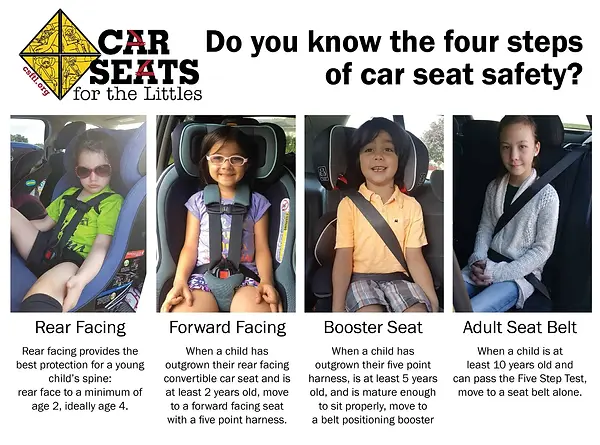
Each year, thousands of children are injured or killed in traffic accidents. The proper use of child safety seats, booster seats, and seat belts can help keep infants, toddlers, and small children safe in a crash. All children 12 years old and under should always ride properly restrained in the backseat. Children who sit in the front passenger seat, even if they are properly secured in a safety seat, risk injury or death should the vehicle be in a collision that causes the airbag to deploy.
Infants who weigh less than 20 pounds and are under 1 year of age should always ride in a rear-facing child-safety seat. Once a child is more than 1 year old and weighs at least 20 pounds, he or she can use a forward-facing safety seat. There are many different brands of safety seats on the market, so always read the manufacturers' installation instructions very carefully to be certain that the seat is properly installed and will properly protect the child. Children should continue to ride in safety seats until they weigh at least 40 pounds.
Children who weigh 40 to 80 pounds should use a booster seat, which will raise the child up high enough so that the lap and shoulder belts in the backseat will fit correctly. Because seat belts are designed to fit adults, a child should continue to use a booster seat until he or she is at least 4 feet 9 inches tall.
AIR BAGS
Side and front air bags have been proven to be effective safety devices. An air bag is a flexible membrane or envelope. When a head-on or nearly head-on collision occurs, air bags inflate rapidly with air or another gas to cushion the vehicle's passengers. The bag has small vent holes that allow the propellant gas to be (relatively) slowly expelled from the bag as the occupant pushes against it.
Air bags should always be used with a safety belt. Air bags supplement the safety bell by reducing the chance that the occupant's head and upper body will strike some part of the vehicle's interior. They also help reduce the risk of serious injury by distributing crash forces more evenly across the occupant's body.
In 1984, the federal government required all newly manufactured cars to have driver's side air bags by 1989. More than 15,000 lives have been saved by air bags in the years since. Initially, most vehicles featured a single air bag, mounted in the steering wheel to protect the driver of the car (who is most at risk for injury). During the 1990s, air bags for front-seat passengers and separate side-impact air bags, placed between the door and occupants, became common. In 1991, Congress mandated that all new passenger vehicles be equipped with driver and passenger air bags by 1998.
Statistics show that passengers in cars equipped with air bags have approximately 30 percent less chance of dying in an accident than in comparable cars without air bags. Despite this, air bags have caused some controversy, as the initial expansion of the bag is a violent event. Air bags deploy and inflate in about 1/20-th of a second and have on rare occasions caused serious and sometimes fatal injuries. For example, if unrestrained occupants slide forward in their seats during braking prior to the crash, they may come into direct contact with the air bag module when it deploys.
Even properly restrained drivers who sit very close lo the steering wheel can be injured or killed in an airbag deployment. Although manufacturers are always working on ways to improve the effectiveness and lessen the risks of air bags, the National Highway Traffic Safety Administration (NHTSA) recommends that drivers allow at least 10 inches of space between the center of their sternum and the center of the steering wheel.
Air bags are a risk to children seated in the front seat. The force of the air bag deploying can injure or kill a child, which is one of the reasons children under 12 should always be seated in the backseat, properly restrained in a child safety seat or a booster seat.
OTHER VEHICLE SAFETY FEATURES
Other protective devices typically found in vehicles include a steering column that absorbs the energy of a driver thrown
against it rather than remaining rigid. Side-guard beams provide side-impact protection. Headrests protect against whiplash
by helping keep the head and neck erect during an impact. Penetration-resistant windshields help keep objects from
breaking through glass. Anti Laceration glass breaks into fragments without forming sharp edges, helping to reduce cuts.
Still more vehicle safety features include recessed door handles, nonprojecting knobs on the dash panel, breakaway rearview mirrors, padded dashboards, padding on the back of front seats (for backseat passengers), crushable front ends of cars that absorb energy, and passenger compartments that resist being crushed. Some vehicles have inflatable rollover curtains that protect occupants against the series of impacts that happen during a rollover.
WHAT TO LOOK FOR WHEN BUYING A CAR
Today's cars offer many safety features either included as standard equipment or available as additional options. Many insurance companies offer discounts if these features are in your car. Here are some important safety features to look for in a vehicle.
-
Traction and Stability Control. Traction control systems help keep a vehicle's tires from losing contact with the road during acceleration. Stability control systems help prevent a vehicle from skidding sideways. Both are very helpful for keeping a vehicle on course in emergencies or in foul weather.
-
Antilock Brakes. When used properly, anti lock brakes allow a driver lo stop straighter and faster. especially on slick or
-
wet surfaces.
-
Safety Belt Tensioners. Automatic safety belt tensioners instantly make the bell snug in a crash lo better protect occupants from being thrown from the car.
-
Head Restraints. Head restraints are designed lo prevent front seat occupants' heads from being snapped back if a vehicle is rear-ended. Some new vehicles also have bead restraints for backseat passengers.
-
Advanced Front Air Bags. Vehicles that are equipped with advanced front air bags adjust their inflation force to a passenger's weight and the crash conditions.
-
Side-Impact Air Bags. Side-impact air bags give additional protection lo the head and torso during a crash.
AUTO MAINTENANCE & SAFETY CHECKUPS
A motor vehicle is a complex machine that requires frequent checkups and adjustments lo continue to operate safely. Miles of driving gradually wear down all the parts of a vehicle. As parts wear out, unsafe operating conditions develop. Regular vehicle checkups and repairs will help prevent the car's parts from failing because of normal wear and tear. The owner's manual that comes with a vehicle provides valuable information about the maintenance schedule and the proper use of the vehicle's equipment.
You can make the following simple safety-related checks. Have your parent or merit badge counselor observe and supervise your work as you go through the list. These simple checks, along with proper preventive maintenance, will help ensure that the vehicle is in safe operating condition.
SAFETY BELTS
-
Check the belts, buckles, and belt retractors periodically, and make sure that the belts are not twisted or excessively frayed. Check the mounts that hold lap and shoulder belts to the floor and the roof. Inspect them for damage and looseness, and replace any damaged equipment.
-
If the belts in the vehicle were worn during a crash, have them inspected and replaced if necessary. The crash may have weakened them and reduced their ability to protect passengers during another crash.
-
When bells become dirty, use only mild soap and lukewarm water to clean them.
-
Never bleach or dye a belt. This can reduce the belt's overall strength.
LIGHTS
Properly functioning lights help make a vehicle visible to others at night or during poor
weather conditions. They also allow the driver to see other vehicles, pedestrians, and
hazards in or near the roadway. You can make the following simple checks on the front
lights. First be sure the engine is off, the vehicle is in park, and the parking brake is on.
Make sure an adult is present, because you will be using the ignition switch and you will need help checking the lights.
-
Turn on the parking lights and check that both front parking lights arc lighted.
-
Turn the headlights on, and check that they are working.
-
Cars have both low-beam and high-beam lights. The high-beam light allows the driver to see farther down the road at night when other cars are not oncoming. Alternate between the low- and high-beam lights. Be sure that the lights work in each position. Move to the front of the car and check tl1at all light lenses are free of dirt. Dirty lenses can greatly decrease the headlights' ability to light the road.
-
Check lo be sure aII dashboard lights are working and all instruments are properly lighted.
-
Operate the turn signals to make sure each front and rear directional signal light works. This step may require that the ignition switch be turned on. This should be done by an adult or under close a.dull supervision. The directional-signal indicators on the dashboard will flash if the turn signals are operating.
-
Check the emergency flashing system. Turning the system on will cause all turn-signal lights to flash at the same lime. Emergency flashers should not be used during normal driving conditions.
-
Using the manual switch, turn on the dome light (interior light). Then turn the manual switch off and open each of the doors (one at a time) lo be sure that the interior lights come on automatically.
-
If the vehicle has any special lights, such as fog lights, check them also.
Now inspect the rear of the vehicle.
-
Move the light switch Lo the parking light position. Tail lights and the rear license plate light should be lighted.
-
Move the light switch for the headlights to the "on" postilion. Again, all rear lights should be lighted.
-
Have an adult push the brake pedal. All brake lights should be lighted for as long as the brake pedal is pushed. The ignition switch may again have to be turned on, and Ibis should be done only with adult supervision.
-
Now ask the adult to press the brake, start the car, and put the gearshift lever into reverse. Stand safely clear of the rear of the vehicle while you check that both backup lights are working.
-
Be sure all switches and controls are returned to the proper "off" positions after your check.
_jfif.jpg)
WINDSHIELDS AND WINDOWS
Both sides of the windshield and windows should be kepi clear and clean at all times. If the glass is cracked or broken, lhe window or windshield should be replaced. Be sure stickers or heavily tinted windows do not block the driver's vision. In most states, all required stickers should be in the lower right-hand or left-hand corner of the windshield. Under adult supervision, use tbe following procedure to check that windshield wipers are operating properly:
-
Wet the windshield with plenty of waler so that dry, hard dirt will not scratch it.
-
Put the vehicle in park and engage the parking brake. Turn on the vehicles ignition and switch on the windshield wipers. If the wipers operate at variable speeds, check each speed. Each wiper arm and blade should sweep across the windshield with a smooth, even motion without hitting the other blade or any part of the frame. Turn the wipers off.
-
Check the rubber wiper blades. They will need to be replaced from time to time, because summer heat and wimer ice damage them. Many drivers give little thought to the blades until they need to use them. Check the blades with a simple "smear-and-clear" test. Mix soap powder or liquid soap with a small amount of water and whip the suds until they are thick and heavy. Smear or spray the solution onto the windshield and turn on the wipers. If the rubber blades do not clear the glass completely in about three wipes, they should be replaced. Try the same test with the new wiper blades and notice how quickly they clean the glass.
The windshield washer is also necessary for good vision in bad weather or when your windshield becomes dirty. Every time you open the hood for an oil check, check the fluid in the washer container. In cold winter months, be sure to use winterized washer fluid, which has additives to prevent it from freezing.
TIRES
The condition of the tires dramatically affects a driver's ability to control his or her vehicle. The design, tread, and inflation of the tires and the condition of the road - wet, icy, or dry - are important factors. When tires do not hold to the road during acceleration or braking, a vehicle can go into an uncontrollable skid. It is important to check a vehicles tires to determine conditions that may cause poor traction or skidding.
Follow this simple procedure to check your vehicle's tires, including lhe spare.
-
With a tire gauge, check the air pressure in each tire to make sure it matches the recommendations in the owner's manual. Overinflated or underinflated tires can negatively affect a car's braking, stability. and ability to turn. Incorrect tire pressure can also decrease gas mileage and cause tires to wear out more quickly. Always check the tire pressure when the tires are cold, since pressures can increase 6 psi (pounds per square inch) or more when the tires are hot from driving. Check the owner's manual for more information.
-
Check the sidewalls and treads for cracks, curs, bulges, blisters, and embedded nails, glass, or other foreign objects. (Do not rub your hand over the tire because you could cut yourself if something is embedded in the rubber.)
-
Check the tread carefully. Badly worn or bald tires can cause skidding, particularly when it is raining. A tire needs replacing when the tread is worn down to 1/16 of an inch. Some tires have wear indicator bars built into the tread. When the tread is
worn down to the solid bar of rubber across the width of the tread, it is time to replace the tire. A simple test to measure tread depth on a tire is to place a penny with Lincoln's head upside down and facing you into a tread groove. lf the top of Lincoln's head is visible, then it is time to replace the tire.
When replacing tires on a vehicle, follow the vehicle the manufacturer's recommendation for tire type and size. When your family buys new tires, be sure to gel good-quality tires, and make sure all four tires match. New tires should be professionally balanced. Your tires will wear unevenly if your tires are not balanced and aligned properly. If the vehicle pulls to one side when it is driven on a straight, level road, the car is probably out of alignment. This will cause uneven wear to the tires, which can ultimately cause a blowout. The mechanic should check for this problem.
MOTOR VEHICLE INSPECTION AND REGISTRATION
The goal of state inspection and registration programs is to ensure that vehicles are properly equipped and maintained for
safe use. They also help ensure that vehicles are driven safely by making sure the vehicle and the responsibility for driving
the vehicle is registered to a specific person.
Depending on the state, inspections may be required once or twice a year. Some states make inspections at random by stopping cars on the road, and some require an inspection when a car is sold. Find out how often inspections are required in your state.
All states require that automotive vehicles be registered and licensed with the state.
Keeping records of vehicles in this way helps make highways safer by giving officials ready information about who owns the vehicle and is responsible for its safe operation; reducing the chances of the theft of a vehicle; and aiding in inspections and recalls for repairs of manufacturing defects.

TWO ITEMS YOU MUST CARRY WITH YOU WHEN YOU DRIVE
In the United States, any time you drive a vehicle, you
must carry the following items with you:
-
A current driver's license from the state where you live
-
Proof of insurance on your vehicle
Failure to comply carries steep penalties, including the lossof your driver's
license. If you drive without insurance and you have an accident, you and
your family will be personally responsible for all costs associated with
replacing or repairing your vehicle, the vehicles you hit, and for all medical
costs associated with injuries, which could amount to hundreds of
thousands of dollars. You may also be subject to lawsuits by the injured
parties and their insurance companies.

_jfif.jpg)
SHARING THE ROAD
As a Scout, you understand the importance of sharing and working together to make sure things go
smoothly. Scouts always have backup plans in case of emergencies. The same should hold true for
Scouts on the road. Safe driving means sharing the road with other drivers and being aware of those
who are using the road with you. Sometimes it means putting your defensive driving skills to use by
avoiding people who are driving recklessly or noticing a child on a side street and braking in time to
avoid hitting the youngster as he or she darts out into the street after a ball. Safe driving also means
sharing the road with everybody who uses it, including pedestrians, bicycles, motorcycles, trucks, buses. and stray or wild animals.
BIKE SAFETY
Riding a bike in traffic with bigger, faster, heavier four-wheeled vehicles is often dangerous and scary. The number of bicycles and vehicles sharing the road continues to grow every year and so, too, do accidents involving both. In traffic, bicycles are considered vehicles and traffic laws that apply to cars also apply to cyclists. Rules of the road to help ensure bicycle safety include the following:
-
Always ride on the right side of the road, with traffic, just as cars travel. It's the Jaw. Never ride against traffic. Drivers do not expect to meet a bicyclist when they round a corner or go over a hill.
-
Obey traffic signals and signs. Be extra careful al crosswalks. Walk 1he bicycle across busy intersections. Walch for turning vehicles, and make eye contact with drivers to make sure they see you.
-
Always check behind you when changing lanes, and use hand signals to indicate turns, lane changes, and stops.
-
Keep yourself a safe distance from cars and be prepared to slop. Keep your hands on or close to the brakes and allow yourself enough room to slOp under the conditions in which you are riding. Ride al least 3 feet away from parked cars.
-
Be predictable and ride in a straight line. Do not swerve or make sudden turns. Drivers may not be able to react fast enough to avoid colliding with you.
-
Never carry a passenger on your handlebars.

RULES OF THE ROAD
Cyclists are subject to the same laws as the drivers of motor vehicles, and they are safest when treated just like motorists. That means you need to follow the same rules of the road as motorists do—and use a few special techniques that apply only to cyclists.
Scanning and Signaling
A key part of following the rules of the road is learning how to observe traffic and making your intentions clear to other drivers by scanning and signaling. Scanning means taking measures to be aware of traffic that’s around you in all directions. Signaling is like asking the question, “May I move from where I am now?” When you signal, a driver should respond in some way—by slowing down to let you into the lane, changing lanes to open a lane for you, or actually giving you a signal, as if to say, “Yes, you may move.” You must receive the driver’s response before changing your riding position on the road.
Your signal alone does not make it safe for you to change position on the road. One reason is that the vehicles in the other lane have the right of way. You must wait for an opening to move into a new lane. If possible, plan your changes early enough to deal with two drivers. If the first driver does not permit your action, the second one most likely will. Mirrors are good for keeping track of vehicle traffic behind you, but the only way you can keep tabs on traffic beside you is to look. Do not rely upon your hearing; cars can be very quiet in motion, as can bikes.
When cyclists turn their head to scan, they often turn the handlebars in the same direction. Practice scanning in an empty parking lot to develop the skill of riding straight without swerving as you turn your head to look. Although you should signal with your left arm, in heavy traffic a turn of your head can suffice as the only signal in cases where you must keep both hands on the handlebars, ready to brake if necessary.
WHERE TO RIDE
The first rule of the road is: Ride on the right side of the road, with the flow of all other vehicular traffic. One of the most frequent causes of car-and-bike accidents is cyclists riding on the left, pedestrian style, facing the flow of traffic. Riding on the right lets you approach drivers on side streets and pedestrians on sidewalks from the direction they expect, the one from which traffic normally comes. When you ride on the right side of the road, drivers also have more time to react to you and just have to slow down to avoid or pass you. Right-turn signal Stop or slow-down signal You should not ride on sidewalks. Not only do you interfere with pedestrians on sidewalks, but you also actually put yourself at more risk than when you are on the road because drivers at intersections and driveways are less likely to see you. (This restriction does not apply to established bike paths.) The standard vehicle code for all road users states, “All persons have an equal right to use the highways for purposes of travel by proper means, and with due regard for the corresponding rights of others.” The second rule of the road, then, is: Slower traffic keeps to the right, and faster traffic passes on the left. A cyclist should ride to the right as far as is safe—which does not mean you should ride at the very edge of the road. In fact, you should typically ride about 3 feet away from the pavement’s edge, as well as from parked cars, hedges, and other obstructions.
If you ride any closer to the edge, you may encounter road debris, crumbling pavement, or a car door that suddenly opens in your path. If cars to the rear are trying to pass you, you can move to the edge of the road while they do so. This allows them to pass you without moving too far into the other lane. Many country roads and city streets are so narrow that cars can’t pass you without moving partway into the next lane. When cars are approaching you from both directions, and on blind curves where there might be oncoming traffic, take the middle of the lane to discourage drivers from unsafe passing. Look and signal before you move.
Do not forget that you have the same right to use the road as a motorist. Make motorists slow down for you if safety warrants it. Be courteous and give a “slow” signal to tell the driver behind you that it is unsafe for him or her to pass. When motorists approach from the rear, they are required to slow down and follow if they cannot safely pass. However, you should not delay faster drivers unnecessarily. If you are going the same speed as other vehicles, pull into line with them. If you must pass slower vehicles, look back for a safe interval in traffic and signal before moving left into the passing lane. (Do not pass on the right; drivers expect faster vehicles to pass on the left.) Make sure you are visible to the driver at this point. Don’t ride too close to the vehicle you are passing. After you pass, return to the right lane as soon as is convenient. If your lane is clear, you may move toward the center of the road to avoid debris, sand, gravel, or other hazards.
On roadways that have two narrow lanes for each direction, ride in the middle of the right lane at all times. Drivers need to get the idea that they must move into the passing lane if they want to pass you.
Do not weave among parked cars. You become invisible to drivers and will have to swerve back into traffic when you reach the next parked car.
If the roadway has a usable paved shoulder or an extra-wide right lane, you may ride in a line that is consistent from the left side of the right lane and about 3 feet to the right of where the cars are traveling. This lets motorists see you and helps prevent you being cut off by a driver turning right, as in the illustration below.
If the vehicle you are passing speeds up while you are beside it, wait until you have fallen behind, look back to the right for traffic and merge back to the right when it is safe to do so. In narrow-lane conditions, riding all the way to the right invites a car to try passing you in the same lane, possibly forcing you off the road.
HANDLING INTERSECTIONS
An intersection is any point, including a driveway, where the paths of two vehicles can cross. There are ways to get through an intersection as easily and safely as possible. First, always move to the lane position that will allow you to ride through most efficiently. To turn right, get to the right side; to go straight, stay near the middle; to turn left, move just to the right of the center of the roadway or into the left-turn lane.
The cyclist’s turning-lane rules are as follows:
-
Select the rightmost lane that goes to your destination (the left, middle, or right lane).
-
Ride on the side nearest your destination if one lane goes in two directions, such as left and straight-through center lanes.
Right Turns. Right turns are the easiest turns. From the right side of the right lane, look both ways for oncoming traffic, signal, and go around the corner. At an intersection with a stop sign or where right turns at a red light are allowed, you must stop and yield the right-of-way to traffic already in the intersection. You also must yield to pedestrians in the crosswalks. A right-turn signal is necessary to let drivers know your intentions.
Left Turns. Left turns are the most complex traffic maneuvers a cyclist can make. In areas where traffic is light enough to permit it, you should execute left turns from the center of the roadway, meaning the lane from which no cars on your left will go straight ahead. Turning left from this position puts all the traffic you might have to deal with in front of you. It allows through traffic to pass on your right, and it doesn’t require you to look back when turning.
If the traffic at an intersection is too heavy for you to ride through safely, it’s OK to make the left turn as a pedestrian. Ride to the far right corner of the intersection, come to a complete stop, dismount from your bike, and look for traffic in all four directions. Now, wait like a pedestrian until traffic clears, then walk your bicycle safely across the street.
On one-way streets with two or more lanes, you may ride on either side of the road. The easiest way to make a left turn from a one-way street onto another one-way street is to ride around the corner on the left, then change lanes to the right as soon as you are certain the roadway is clear and operators of vehicles behind you are aware of your intentions. Never pass the last in a series of cars stopped and waiting at an intersection. You do not know which way the car will go, or whether it is hiding a pedestrian or other hazard. When moving into position within a lane, look back for traffic clearance first. When changing lanes to get into position, look back to let a driver make room for you, make a left-turn signal, cross to the other side of the lane, look back again to let a driver make room for you, and cross the line into the new lane. To cross multiple lanes, repeat the process as needed.
Going Straight. When going through an intersection, make sure traffic turning right passes you on your right. Ride to the left side of dual-destination lanes (lanes from which vehicles can go straight or turn right) and stay completely out of right-turn-only lanes.


Where in the lane should you be to prepare to make your left turn? If the lane is also for through traffic, ride on its left side (A). If the lane is a left-turn-only lane, ride on its right side (B). You must yield to other traffic in the intersection—both vehicular and pedestrian. Pass oncoming left-turning vehicles right side to right side (C). When you are turning left from the left side of the lane, don’t let left-turning cars behind you pass on the right. While waiting to turn left, move to the middle of the lane and make a slow signal with your left hand to inform the motorists behind you.

The simplest-looking yet most difficult intersection to ride through is one on a small, two-lane street, where the traffic in the right lane can go left, straight, or right. To discourage drivers from passing you on the left and then turning right, ride a little farther into the lane as you approach the intersection. Position yourself far enough from the curb to allow drivers to make legal right turns on a red light if you are going straight. You might need to gesture to such drivers that it is OK for them to turn between you and the curb.
HANDLING HAZARDS
Motor Vehicles in General
Getting hit from behind on a bicycle happens infrequently and usually occurs when a driver loses control of a vehicle. Because you can do little to recognize or prevent this situation, heads-up riding is the only survival strategy you can use. You can do something about drivers underestimating your speed and cutting you off as they overtake you. While you look ahead, keep track of the passing vehicle out of the corner of your eye. If the car merges too soon, slow down to give it space, or, if necessary, take a safe route off the road to avoid it, especially if it is a long vehicle like a bus, a tractor-trailer rig, or a truck pulling a trailer.
When a string of cars is coming toward you on a rural road, watch for one of the trailing cars to pull out and pass the lead vehicle. Give it space if necessary. A head-on collision could occur if there’s not enough room for the passing car to get back into its lane before it reaches you. Since this type of accident occurs partly because the motorist cannot see the cyclist ahead, it is a good idea to wear a conspicuous helmet and bright clothing to increase your visibility.
Emergency Vehicles
Emergency vehicles always have the right of way. Bicyclists should take this rule one step further. As soon as you hear the siren or see the lights of emergency vehicles, pull off the roadway as quickly and safely as you can. Drivers of vehicles are trained to look for the emergency vehicles and clear the way for them. During this process, their ability to deal with a bicycle on the road is reduced. The best thing to do is get off the road and wait until the emergency vehicle passes. The general rule in the presence of police cruisers, fire department equipment, or ambulances is “Sirens or lights, drive right.”
Although motorists demand much of your attention when you are riding, you should also keep an eye on—and cooperate with—other cyclists. We’ll discuss this topic in the chapter on touring. Because hand brakes do not work as well in the rain, squeeze the brakes lightly and regularly to help keep the rims dry so that you can stop quickly when necessary. Allow extra room for stopping.
Always Wear A Helmet
About 75 percent of deaths and permanent disabilities resulting from cycling accidents involve brain injuries. A helmet is the most important piece of equipment a cyclist can own and use. In fact, the National Highway Traffic Safety Administration says bicycle helmets can reduce head injuries by 85 percent. So, even if your state doesn’t require helmet use, you should always wear a properly fitted helmet when riding your bike. To protect your head, a helmet must do two things:
-
Gradually slow the momentum of the skull and act as a shock absorber. A good helmet should have a lining of rigid, crushable foam at least half an inch thick. This lining reduces the severity of damage to the brain when it bangs against the skull as the head hits a hard surface.
-
Prevent sharp items from reaching your head. To do this, a helmet should have a rigid shell covering the foam layer. The shell distributes the impact of a sharp or hard object over a larger surface, reducing the chance of penetration. Helmets with fabric covers do not provide the protection of shell-covered helmets. Shell-covered helmets can slide along the road surface in an accident, while fabric-covered versions tend to grab on the surface and could twist the rider’s neck.
Select a shell-covered helmet that closely matches the size of your head and is comfortable. Most helmets come with a selection of replaceable pads of various thicknesses that you can use to fit the helmet to your head.
-
Too far back - The helmet should have four fully adjustable ear straps. Wear your helmet so that it covers your forehead to just above the eyebrows. Adjust the straps so that the helmet stays in this position on your head. The chin strap should be easy to fasten and unfasten.
-
Too far forward - To increase visibility, select a helmet color that is bright and reflective. You can apply reflective tape or stickers to the helmet to help other vehicle operators see you. Also, a light-colored helmet will help keep you cool in the hot sun, as will one with large vents.
-
Correctly positioned - Even if it shows no damage, a helmet must be replaced if it has been worn in an accident, because the foam protecting the head will have been crushed. The helmet should also be replaced when any of its parts show wear, or if it has been used for more than three years. In terms of your safety, a helmet is a very inexpensive precaution.

STEPS TO TAKE AFTER AN ACCIDENT
Accidents can be extremely scary experiences, so it is important to "be prepared" beforehand as to what steps you should take if you are ever involved in a car collision.
-
Stop your vehicle as soon as it is safely possible. If you cannot stop quickly, stop as soon as you can.
-
If there is only minor damage and you can safety do so, move the vehicle off the road. If it is too badly damaged to move, turn on the hazard lights to make your vehicle visible to other drivers behind you. If there is only minor damage and you can safely do so, move the
-
Turn off the ignition and check for gas leaks. If you see any fluid leaking from underneath the car, get away and stay clear of the immediate area. Make sure you and any passengers, or occupants of other vehicles involved, are out of the way of traffic.
-
Stay calm. Adrenaline may be pulsing through your body right now, but don' t lose your cool. Check yourself and others for any injuries. If a person is seriously injured, do not attempt to move him or her unless there is immediate danger.
-
Call the police and ask for an ambulance if needed. Alert the police to any injuries and make sure you let them know if the accident is blocking the roadway. Get your bearings first so you can tell them where the accident is located.
-
Exchange information with the other driver. All drivers involved should exchange their name, telephone number, address, driver's license number, the name of their insurance company, the insurance policy number, and insurance company's phone number. Write down the make, model, year, and license plate number of the vehicle or vehicles involved and the names of any passengers that were in vehicles at the time of the accident.
-
If it is a serious accident and people stop to help, ask them to write down what they saw along with their name and telephone number. This is called a witness statement. If it is a serious accident and the witness cannot stay until police arrive to help, ask them to sign their statement and leave it with you to give the police. If you can, draw
a diagram of the scene, showing where the cars were located and in which lanes the vehicles were traveling at the time of impact. Write down the date, time, and any contributing weather or road conditions. -
Many law enforcement officers and insurance companies suggest that drivers carry a disposable camera with film in their glove compartment so if they are involved in an accident they can take pictures of the damaged vehicles, the roadway where the accident happened, and any skid marks.
-
When you speak with police, remember to answer their questions politely and say "sir" or "ma'am" when you speak to any adults or law enforcement personnel. Give your account of what happened as calmly as possible. Have your insurance information and your driver's license ready to show them.
-
So that you will know where to get a copy of the police report, find out the specific police department, sheriff's department, or highway patrol that responded to the accident.
-
Don't leave the accident until police release you to do so. If your vehicle is too badly damaged to drive it safely, call a tow truck to take it to your home or a repair shop.
-
Once you are cleared from the scene and able to, contact your insurance company. Give them the information about the accident and the contact information for the other person's insurance company.
MOTORCYCLE SAFETY
Motorcycles use the same roads as cars and trucks and travel at similar speeds. A
motorcycle, however, has two significant differences: instability and vulnerability. A
motorcycle's two wheels cannot provide the same stability as a car's four wheels and thus
requires more physical coordination than driving a car. Road conditions such as potholes,
gravel, wet or slippery surfaces, pavement seams, railroad crossings, and grooved
pavements that are minor annoyances to motorists can be major hazards to a motorcycle
rider.
Before you get out on the open road on a motorcycle, take a nationally recognized course in motorcycle safety and defensive driving. Then get a lot of practice on rural roads and quiet side streets before you venture out in traffic. Because motorcycles vary in handling and responsiveness, you should ride a new or unfamiliar machine only in a controlled area until you are confident you can operate it safely.
On a motorcycle, a person does not have the protection that a car's metal body structure affords, so a motorcyclist is much more vulnerable to injury. For this reason, motorcyclists must drive extremely defensively. In collisions between motorcycles and other vehicles, drivers often report that they "just didn't see the motorcycle." Riders can enhance their visibility by applying reflective materials to the motorcycle, wearing bright-colored clothing, keeping the motorcycle headlights on at all times, and weaving slightly within the lane when they are behind a motorist so that the motorist will become aware of the presence of a motorcycle.
PEDESTRIAN SAFETY
Pedestrian safety is a serious issue because people who are walking across a roadway lose in any accident with a vehicle. Each year, nearly 5,000 pedestrians die in traffic crashes. Greater caution and courtesy by both drivers and pedestrians could prevem many of these fatalities. Pedestrian safety means much more than just getting out of the way. Pedestrians must follow the rules and messages conveyed by roadside signs and markings. Here are specific safety guidelines for pedestrians.
-
Always try to cross the street at a crosswalk or an intersection with a traffic signal. Even with traffic controls. intersections are dangerous for pedestrians. A significant percentage of pedestrian accidents occur at intersections. Be sure you look behind you and all around you for approaching cars before stepping off the curb.
-
When crossing a street. stop and look left. then right. then left again, before stepping out. If you see a car, wait until it goes by and then look left, ,right. and left again until no cars are coming.
-
Dress to be seen. Brightly colored clothing makes it easier for drivers lo see you during U1e day. Al night, wear white or light-colored clothing and reflective material on your shoes, cap, or jacket to reflect the headlights of cars coming toward you.
-
Walk on sidewalks whenever they are available. If there are no sidewalks, walk facing traffic so that you can see any car that might go out of control. Walk as far of( the roadway as possible.


PEDESTRIAN CROSSING SIGNALS
Pedestrians need to understand crossing signals. Some signals at pedestrian crossings use "Walk;' or the symbol of a pedestrian, which means pedestrians may cross the street after making certain it is safe. A flashing "Don't Walk" message or the flashing orange symbol of a hand is a warning that the permitted time period for crossing is ending. Pedestrians already in the street should continue across to the other side or to a safety island. Pedestrians still on the curb should remain there until the next "Walk" signal. A steady (nonflashing) orange "Don't Walk" or a steady orange hand symbol means that pedestrians are not permitted to leave the curb because the light is about to change or has changed.

SCHOOL BUS SAFETY
More than 20 million students ride the bus to school on weekdays. School buses are one of the safest forms of transportation around. The greatest potential danger is not in riding the bus but in getting on and off or in moving around the bus.
Here are some safety guidelines for boarding and getting off of school buses.
-
Be at the bus stop at least five minutes before the bus is due to arrive. If you are late for the bus, do not run recklessly across a street or down a road to catch it.
-
When the bus approaches, step back and stand at least five long steps (10 feet) from the curb. That way the bus driver can pull up to the curb so you won't have to walk out into the street to board.
-
Wait until the bus comes to a complete stop. the door opens, and the driver says it is OK to board before stepping onto the bus.
-
If you drop something near or under the bus while getting on or off, tell the driver. Make sme the driver sees you, knows you are there, and won't begin to drive away as you are trying to pick up what you dropped.
-
Use the ilandrail when you get off the bus. II will help you keep your balance if you stumble.
-
Make sure that key chains, clothing, or your backpack does not snag on the handrail or get caught in the door. You could be dragged along beside the bus if the bus driver does not notice you and drives off.
-
When getting off a school bus, walk three steps away from the door. Stay away from the bus's wheels and watch out for moving cars.
School buses have a number of safety features.
-
Yellow flashing lights mean the bus is about to stop and load or unload
riders. Cars must slow down and get ready to stop. -
Red flashing lights and an extended stop signal arm mean the bus has
stopped and passengers are getting on or off. When the lights are
flashing and the stop signal arm is extended, motorists traveling in all
directions must come to a complete stop at a safe distance from the bus
and resume driving only when the red lights have stopped flashing, the
arm is retracted, and the bus has begun moving again. -
Side and rearview mirrors let the driver see what is going on around the bus-the cars approaching, the children walking up to the bus, and the bikes that might be close by.
-
Emergency exits in the bus allow for passengers' quick escape and should be used only in an emergency. In any emergency the riders should listen to their driver for instructions.
-
A crossing control arm is mounted on the front bumper and swings out when the door is opened. The arm is designed to keep children from walking close to the front of the bus.

NAVIGATING THE ROAD
Becoming skilled in reading road signs, signals, and markings is important to your safely on lhe roads and highways. Equally important is learning and practicing safe, defensive driving skills and I.earning lo anticipate and avoid potentially unsafe situations.
TRAFFIC SIGNALS
A traffic signal is a traffic-control device that is designed so that everyone should instantly understand the message. Traffic signal design is standardized internationally for that reason.
Red Light - STOP. A red light always means stop. All states permit a right turn on a red light-after a stop unless a signal prohibits it.
Red Arrow - STOP. A red arrow light means that no turn is permitted in the direction of the arrow.
Yellow Light - CAUTION. A yellow light means that you should enter the intersection only if you can do so safely.
Yellow Arrow - Caution. A yellow arrow light means that if you can do so safely, enter the intersection with caution and yield to oncoming traffic.


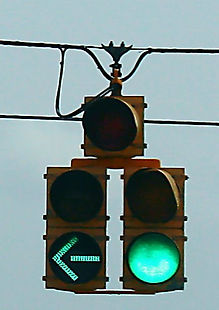
Green Light - GO. A green light means go, when and if it is safe to go. You may have the right-of-way, but always be sure 1he intersection is clear before.
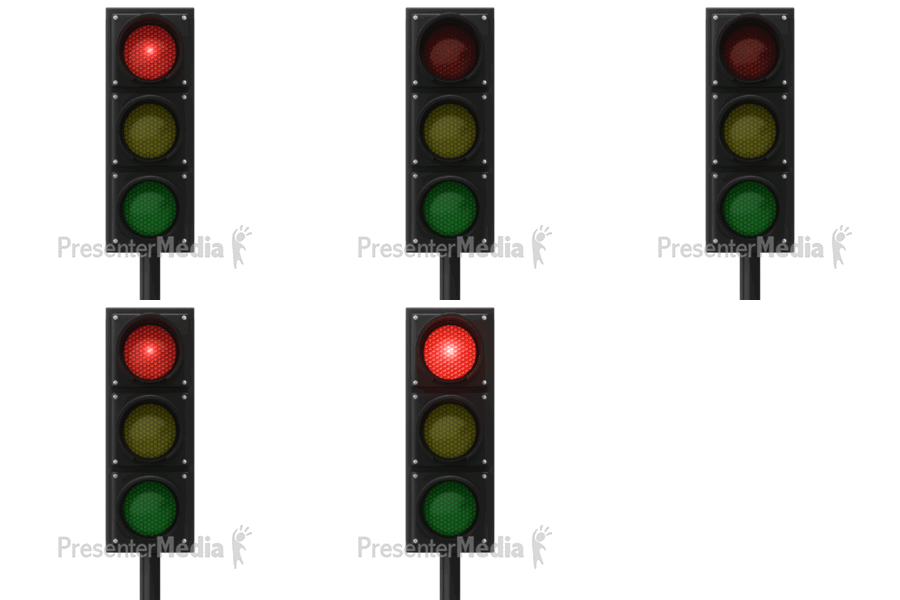
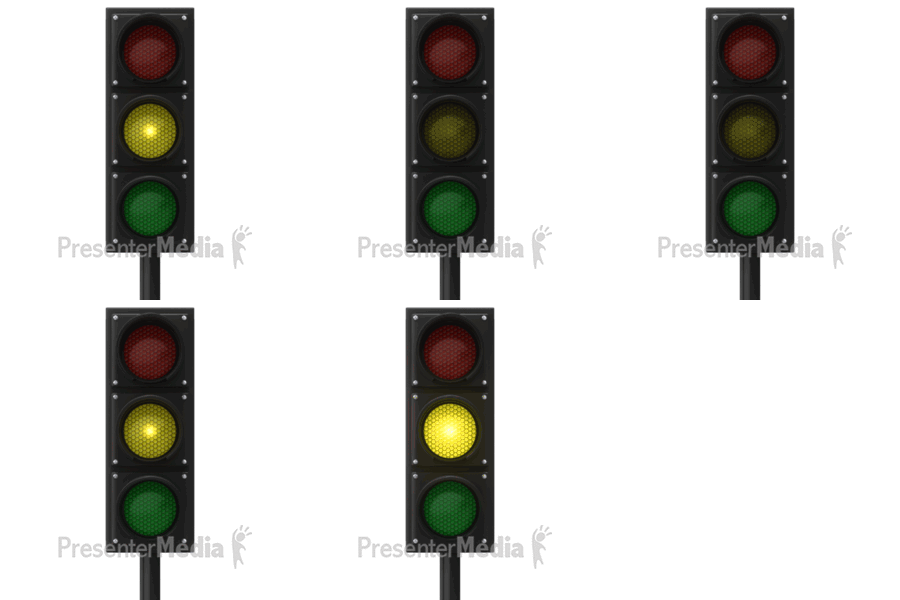
Flashing Yellow - SLOW DOWN. Proceed with caution.
Flashing Red - STOP. A flashing red light is the same as a stop sign. After stopping, proceed with caution when it is safe.
Green Arrow - GO. A green arrow light means to go, only in the direction of the arrow, when it is safe to proceed.
TRAFFIC SIGNS
The shapes and colors of traffic signs have meaning. Some signs, such as "Stop'' and "Yield," are so important that each has its own distinctive standardized shape and color. Other signs are grouped by color and shape. Most signs fit inlo six groups.
Regulatory Signs. Regulatory signs are typically rectangular, with black words or pictures on a white background. The "Stop" and "Yield" signs are exceptions. Symbol signs often include a red circle with a crossbar to indicate a prohibition. Motorists are required to obey regulatory signs. A police officer can give a driver a ticket for ignoring the message. A speed-limit sign is a good example of a regulatory sign.

Warning Signs. Warning sings are typically diamond-shaped and yellow with black words or pictures and a black edge. They are used to warn drivers of a condition ahead that may not be expected. Exceptions to the shape rule are the round "Railroad Crossing" symbol sign, the pennant-shaped "No Passing Zone" sign, and the pentagon-shaped "School Zone" and "School Crossing" symbol signs, which are fluorescent yellow-green to enhance their visibility.

Guide Signs. Guide signs are the most variable in shape and color. Guide signs include the large, rectangular, green signs used on interstate highways and many freeways to give drivers route and destination information. Guide signs also include street signs and route shields such as the distinctive interstate and U.S. highway shields. Each state has its own standard marker for state and local routes.

Service Signs. Service signs are typically rectangular with white symbols on a blue background. The symbols indicate the availability of services such as gas, food, and lodging as well as phones and hospitals.
_jfif.jpg)
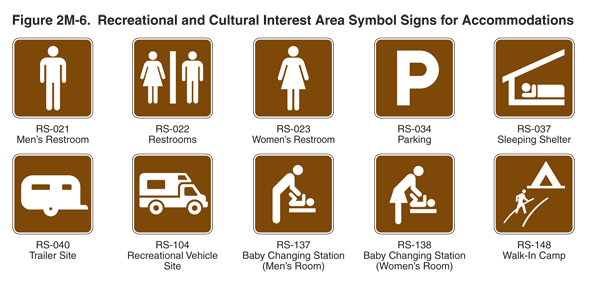
Recreation Signs. Recreation signs indicate that the road user is approach- ing some type of public recreation area such as a camping area, picnic area, or scenic overlook. These signs are rectangular with white symbols on a brown background.
Work Zone Signs. Work zones, such as for highway construction or utility work, are marked with orange signs. These signs have information particular to work zones such as "Flagger Ahead" on a diamond or an ordinary symbol such as the curve warning. Work zones present a special situation that demands that drivers be alert and expect the unexpected. Men and women working on the roads risk injury and death just by being near traffic. Machinery and unfinished roads can pose hazards to drivers. Fines issued in a work zone can be doubled.


PAVEMENT MARKINGS
Pavement markings, which are painted stripes on the road, mark lanes on highways and provide information regarding passing and changing lanes. These markings are typically either white or yellow solid lines or white or yellow dashed lines.
White Lines. Solid white lines mark the right edge of the road and are sometimes called "fog lines." Solid white lines also serve as a visual barrier to discourage lane changing in certain situations, such as in turn lanes at an intersection and where vehicles are entering or leaving a freeway. Dashed white lines separate traffic in the same direction on roads with multiple lanes.
Yellow Lines. Yellow lines mark the left edges of divided highways and separate traffic traveling in opposite directions. Double, solid yellow center lines mean no passing is allowed in either direction. A single, dashed yellow center-line means that passing is allowed if the road ahead is clear.
SCHOOL ZONES & RAILROAD CROSSINGS
Distinctive fluorescent yellow-green signs tell drivers that they are approaching school zones. Drivers should slow down and pay careful attention to warning signs and speed limits that appear along with these markings. Be familiar with signals or markings for railroad crossings as well. A roadway-rail grade crossing presents an unusual traffic situation for motorists. Many drivers do not cross railroad tracks often enough to be familiar with the warning devices designed for their safety. Some ignore all warning signals and markings because they are in a hurry and would rather beat the train than wait for it lo pass.
Driver inattention and impatience are the most common factors contributing to collisions between motor vehicles and trains at roadway-rail grade crossings. Remember motor vehicles always lose in these kinds of collisions.
INTERSTATE HIGHWAYS
Interstate highways are a system of interconnecting highways that crisscross the United States. They aI.·e numbered in a pattern to help aid navigation. One- or two-digit even-numbered interstate routes are east-west highways. Even though locally they might not run east and west, overall they are intended Lo serve east-west travel.) Route numbers increase from south (I-10) to north (1-94).
One- or two-digit odd-numbered interstates are north-south highways. Numbers increase from west (I-5) to east (1-95).
Three-digit interstate highway numbers connect to other major highways. If the first digit is an even number, the highway usually connects to another interstate at both ends, forming a beltway or loop. If the first digit is an odd number, the highway is usually a spur route that connects to another interstate highway al only one end, sometimes going into a city center.
Interstate highways show the distance between points with mile markers placed along the road shoulder. Mile markers show the number of miles from where the route entered the stale, or from the beginning of the route if it starts within the state. The count starts at the state line in the south (for north-south routes) or in the west (for east-west routes). Knowing how to read mile markers can help you:
• Know where you are.
• Determine how far it is to your destination.
• Give an exact location if you need to report an emergency or need assistance.
COMMON DRIVER DISTRACTIONS
Road signs help you know what to expect as you drive down a highway or through city traffic, but as a driver you also must always remain alert and be ready to deal with the unexpected. It is essential to give driving your full attention and keep all distractions to a minimum.
The next time you and your friends head out in the car, whether it is down the street or for a weekend campout, think about the types of distractions you could face that might result in an accident. Here are five of the most common distractions:
-
"Rubbernecking." When drivers take their eyes off the road to gawk al an accident, look at the people in another vehicle, or gaze at the scenery, they cause a considerable number of traffic accidents.
-
Mobile Phones and Other Portable Devices. Mobile phones and devices such as MP3 players also arc likely LO contribute to collisions on the road. When drivers talk on the phone while driving, their reaction limes are impaired to such an extent that they react similarly to the way a drunken driver would. Phones also cause drivers to lake their eyes off the road for precious seconds as they look down to retrieve a ringing phone or search for a phone number. [n those distracIecl moments, a driver could drift into oncoming traffic or fail to see that the car ahead is stopped.
-
Music. A study conducted by the University of North Carolina Highway Research Center found that drivers are six times more likely to have an accident while searching for a radio station changing a song than while glancing at the speedometer or the fuel gauge.
-
Passengers. A driver's passengers can be just as much of a distraction as a mobile phone conversation. The more passengers there are in a car, the greater the risk of having an accident. Drivers should keep conversation with passengers to a minimum.
-
Eating and Drinking. Drivers need to keep both hands on the wheel while driving. Eating or drinking while driving can lead to accidents. In addition, when a driver is trying to eat and drive. his or her focus moves from its proper place on the road lo the fast-food bag on the car seat.
GAUGING BRAKING DISTANCES
An alert and experienced driver knows that a car cannot stop on a dime - Time and a considerable amount of distance elapse between the time you decide lo apply the brakes and the time your vehicle actually slows to a stop. Suppose you are traveling down the highway at 60 miles per hour when you notice a small child in the road. Your vehicle will need approximately 150 feet to 172 feet to stop depending on the road surface and the condition of the brakes and tires. This distances is known as braking distance.
Being able lo judge braking distance is very important, but be aware that ii is not the only factor that affects how far a car will travel before it stops. Drivers also need time to apply the brakes after they have decided to stop. The average time that elapses between making the decision to stop and actually applying the brakes-reaction time-is three-quarters of a second. In this time, with the car going 60 miles per hour, it will have traveled another 66 feet. lf it takes the driver a whole second to react, the car travels 88 feet. If a second and a half pass. the vehicle travels 132 feet. This is known as reaction-time distance (or driver-reaction distance). The table shows approximate braking distances and reaction-time distances on dry, level pavement for well-maintained cars traveling at typical city and highway speeds.

BRAKING DISTANCES AT NIGHT
Visibility decreases at night, impairing a driver's ability to see and react to unexpected situations. At night, when a driver can see only as far as the headlights allow, the
difficulty of stopping in time to avoid an accident
increases. Low-beam headlights allow the driver to spot
an object on the road about 160 feet ahead of the
vehicle, but headlights cannot follow curves, hills, or
dips in the road.

One more lime factor must be considered. This is the period between the moment the driver recognizes there is a dangerous problem and the instant the driver decides to take action and apply the brakes This perception-time distance varies widely, depending on the circumstances and the attentiveness of the driver. The driver could be sleepy or distracted, have poor eyesight, or be under the influence of alcohol or drugs. This factor and the reaction time are highly variable, but they are always present and will lengthen all braking distances.
Weather conditions such as rain, snow, sleet, and ice also can affect stopping distances. On a wet road, stopping requires up to four times the distance normally needed on a tiry road. When driving at about 50 miles per hour during a heavy rain, the water can literally lift the vehicle's tires orr the road. To prevent hydroplaning, you will need to slow down. Heavy rain is not the only factor that can cause a spin or slide. During a light drizzle, a little water combined with the oil that has accumulated on the road produces a slick, greasy film that can decrease traction.
DRIVING AT SAFE SPEEDS
When traffic engineers design roadways, they determine safe speed limits for the road. Traveling too fast for the conditions or in excess of the posted speed Limit is speeding. Many crashes are caused by traveling at excessive speed. The faster a motorist drives, the more time and distance is needed to stop, the less time there is to react, and 1he greater the impact or striking power of the vehicle. If the vehicle's speed doubles from 20 to 40 miles per hour, the impact is actually four times greater. Triple the speed from 20 to 60 miles per hour, and the impact and the braking distance are nine times greater. Drivers should be fully aware of the potential destructive power of a speeding vehicle.
When driving conditions are less than ideal, a person operating a motor vehicle on the highway [s required by law to drive at a careful and prudent speed. You will need to decrease your speed, probably below the pos1ed speed limit, for any of the following conditions:
-
Heavy, congested, or slow-moving traffic
-
Rough, icy, or wet road surfaces, or other circumstances in which traction is poor
-
Narrow roadways that reduce the margin of safety
-
Weather conditions (rain. snow, fog, dust, smoke) that affect sight distance and traction
AGRESSIVE DRIVERS: AVOIDING ROAD RAGE
Despite the legal and safety ramifications of speeding and driving recklessly, you will undoubtedly encounter aggressive drivers on the road and it is best to be prepared. Aggressive drivers are those who run stop signs and red lights, drive too fast, tailgate (follow too closely), weave in and out of traffic, pass on the right instead of the left, make rude gestures, or scream, honk, and flash their lights at motorists who are unlucky enough to be in front of them. Also known as road rage, aggressive driving puts everyone in the vicinity of the aggressive driver in danger. Here is what to do if you are confronted by an aggressive driver.
-
Try to get out of the person's way. Do not further anger the aggressive driver by speeding up or attempting to keep him or her from passing.
-
Avoid making eye contact with the enraged driver.
-
Do not respond to rude gestures, screaming, or incessant honking.
Doing so will likely escalate the situation. If you have a mobile phone,
find a safe place to pull over and call the police (911 or the
emergency number for your local area). Report the aggressive driver
and provide the police with details about the driver's location,
direction of travel, license number, and vehicle make and model.
If you find yourself riding with a driver who is driving aggressively and dangerously, do not grab the steering wheel. Such a move can instantly cause a crash. Try to find a believable excuse for the driver to stop the car. Saying that you are going to be sick probably would work. Then leave and call home for a ride or make other arrangements for safe transportation.
TEN DEADLY TEER DRIVER MISTAKES - AND HOW TO AVOID THEM
This list comes from AAA, the American Automobile Association.
-
Overconfidence. Expect the unexpected. Inexperience and overconfidence can lead to crashes when new drivers encounter unfamiliar or unexpected situations. Practice driving with an experienced adult driver, and gradually take on more challenging driving conditions.
-
Not buckling up. Use a safety belt and insist that all your passengers do so as well. About two-thirds of teens killed in vehicle crashes were not wearing safety belts. Wearing a safety belt reduces your chances of being hurt or killed in a crash by as much as 45 percent.
-
Speeding. Stick to the speed limit. One-third of teen fatalities involve speeding. Driving the speed limit increases your chance to avoid a crash and reduces the severity of a crash.
-
Rowdy passengers. Don't load up your car with friends. Teenage passengers can be a major distraction for novice drivers. Adding one teen passenger to a vehicle increases a 16- or 17-year-old driver's crash risk by about 50 percent. With two or more teen passengers, the crash risk increases fivefold.
-
Talking on a cell phone. Focus on driving; save the phone calls, text messaging, and other gadgets for after the driving is done. Talking on a cell phone while driving slows any driver's reaction time considerably, regardless of age.
-
Fiddling with the CD player or radio. Driving and channel-surfing don't mix. Research shows that adjusting the radio is the most common distraction for drivers ages 16 to 20. Wait until you are safely parked before changing a CD or adjusting the radio.
-
Late-night cruising. Don't drive late at night. Teen crash rates at night (9 P.M. to 6 A.M.) are twice as high as daytime rates. Nighttime driving is more dangerous for everyone, and young drivers are even more likely to be involved in crashes caused by drowsy driving.
-
Drinking and driving. Stay sober. Of 16- and 17-year-old drivers killed in crashes, 16 percent would have been con- sidered legally intoxicated by adult standards. Drinking and driving is never a good idea, especially when you are under- age and still learning to drive.
-
Getting into a bad situation. Make good choices. Teen driver crashes kill nearly as many passengers of teen drivers as they do teen drivers themselves. Before you get in a car with a friend, assess the situation: Is this a person you would trust? Is he in the right frame of mind to drive safely? Is he sober and alert? Are the other passengers likely to influ- ence him to drive recklessly?
-
Taking risks. Know that it can happen to you. Car crashes are the leading cause of injury and death for people ages 15 to 20. And it's not just about you: Crashes affect pedestrians, passengers, and other drivers, as well as their families. You don't want to do something you will regret for the rest of your life.

TRAFFIC, YOUR COMMUNITY, AND YOU
To complete requirement 5, you have three options. If you decide to complete requirement 5a, you will need to interview a traffic law enforcement officer in your community to find out which three traffic safety problems are of most concern to that officer. Discuss these concerns and possible solutions with your merit badge counselor.
If you elect to do requirement 5b, you will need to write personal traffic safety pledge, addressing three (3) of your most concerning issues relating to traffic safety. Show your pledge to your merit badge counselor and discuss your commitment to traffic safety. Use different parts of this merit badge and the internet to help write your safety pledge.
If you decide to do requirement 5c, you will initiate and organize an activity to demonstrate the importance of traffic safety. The remainder of this chapter has a variety of ideas that can be adapted for your merit badge project. These suggestions may help get your creativity flowing and provide the spark needed to create your own project.
ORGANIZING TRAFFIC SAFETY PROGRAMS AND ACTIVITIES
The following are examples of traffic safety programs and activities that young people have successfully developed in their schools and communities.
Buckle Up!
When a high school student in Frederic, Wisconsin, was killed in a crash because he was not wearing a safety belt, fellow classmates launched a "Buckle Up, Frederic!" campaign to educate the community on the importance of using safety belts. The students developed a safety belt survey, which they conducted at the school and at a major intersection in town. The surveys found that only 43 percent of students and 37 percent of other residents were wearing safety belts. They published the results in a brochure that contained other safety belt information and distributed the brochure and other literature to the school and community. Other materials they developed and activities they organized included the following:
-
Displays on safety belt use for a local bank
-
"Buckle Up!" fliers that they placed on car windshields
-
A coloring contest on buckling up for grades 1 through 5
-
Lesson plans for grades K through 8
-
• Presentations to elementary and middle school children
-
A multimedia show on safety belt use for grades 9 through 11
Students wrote articles and editorials for local newspapers and recorded public service announcements (PSAs) with original music that aired on local radio stations. The result? A second survey, conducted after the campaign, showed a 37 percent increase in safety belt use among students and a 33 percent increase in the community overall.
Bicycle Rodeo
Teaching biking safety to younger children by organizing a bicycle rodeo promotes safe cycling in a fun way. A bike event takes lots of planning. Here's a checklist to help you get started.
-
Identify where the bike rodeo will be held and get permission to use the location.
-
Develop event and staffing schedules. Plan contests that challenge balance and control and that test skills needed for safe street riding. Suggested skills include the following:
-
Riding slowly in a straight line for 60 feet. At about 30 feet, the rider should look over his or her left shoulder to check for traffic behind while maintaining a straight line.
-
Maneuvering through an obstacle course to test the rider's ability to change directions quickly.
-
Turning in a limited space to test the bicyclist's ability to turn around smoothly and easily.
-
Signaling with the proper hand signals.
-
Making a controlled stop.
-
Have educational materials on helmets, proper clothing for biking, and other bike safety issues available to hand out to participants at registration.
-
Make a display of helmets to show contestants and their parents the different types available. Be prepared to discuss national safety standards, fit, pricing, and helmet replacement.
-
Invite a uniformed police officer or a member of a bike advocacy organization to be at your event to provide information on bike riding rules.
-
Invite someone from a local bike shop to provide bike inspections.
-
Provide engraving against theft. Engraving a parent's license plate number on the frame of the bike is the easiest way to trace ownership if the bike is stolen.
-
Arrange for refreshments. At the least, have water available. Politely ask local stores and businesses if they would be willing to donate snacks and beverages.
-
Publicize your event. Post fliers, and write press releases to distribute to newspapers, radio stations, and television stations.
BAAM (Bicycles, ATVs, Alcohol, Motorcycles) Program
To help instill a responsible attitude toward driving in teens who have not reached the legal driving age, work with law enforcement agencies and school groups to present a week of traffic safety activities for middle school students. Have students make daily safety tip announcements for bicycles, all-terrain vehicles (ATVs), and motorcycles. Distribute printed materials about the consequences of underage drinking.
More Ideas
Here are some other ideas for traffic safety awareness activities.
-
Organize a mock trial to show the legal consequences of driving while impaired.
-
Have an expert on traffic safety speak at a school assembly.
-
Hold a schoolwide trivia quiz based on traffic safety facts and statistics.
-
Organize a "Save our Seniors" (SOS) program at a local high school. Seniors who sign the SOS pledge will agree to stay alcohol- and drug-free, always wear safety belts, and maintain a clean driving record during their senior year.
-
Organize a program for elementary school students on pedestrian safety.
-
Get involved with an existing group, such as SADD or your student council, to promote traffic safety and the prevention of alcohol and drug abuse.